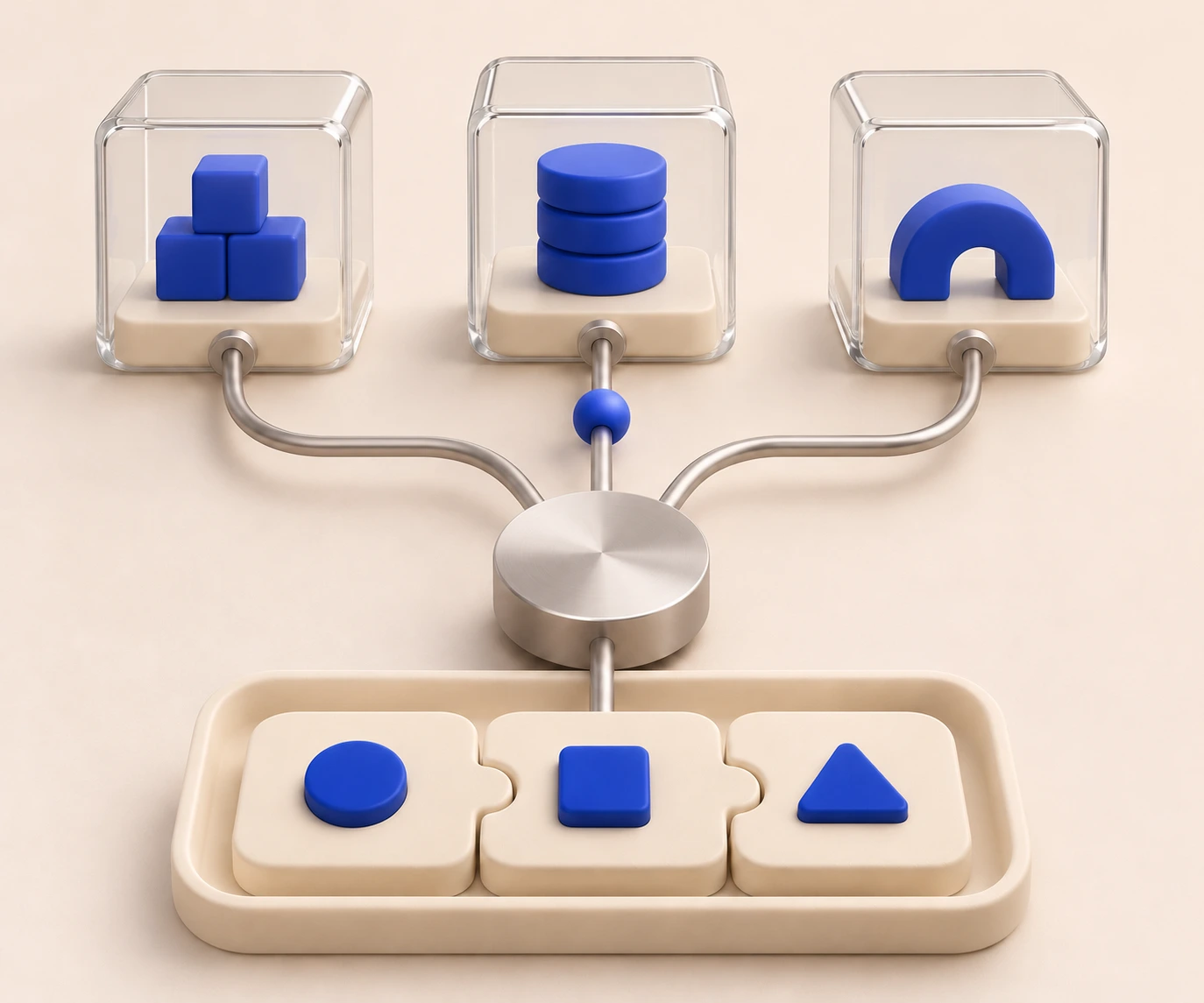
Cloud agent orchestration is the layer that decides which agent, model, tool and sandbox handles each step of a task, runs it in an isolated cloud environment, and keeps the state, retries and audit trail together. Teams that build it by hand end up maintaining a router, a runtime and a tracing stack alongside the product. HarnessRouter treats the agent harness, the model, the provider and the sandbox as configurable modules behind one API, so compatible, supported orchestration choices can be configured for quality, latency or cost without a separate integration for each combination.
This guide covers what the term means, how routing works, which patterns fit which workloads, how to observe and govern a system in production, and where the cost actually comes from.
TL;DR
- Orchestration is the coordination layer: routing, sequencing, delegation, retries and stop conditions. A single agent needs it too, not only multi-agent systems.
- Route each step by task type, capability, load, permissions and runtime conditions, and keep tool access (MCP) and agent-to-agent messaging (A2A) underneath that logic.
- Pick the pattern from the dependency structure of the work: sequential when steps need each other's output, parallel when they share inputs, manager-led when the path is not known in advance.
- Model selection can reduce cost: EvoRoute reports up to 80% lower execution cost on tested agentic benchmarks, while SEAR identifies 90% lower input and 92% lower output token prices for one traffic slice with comparable replay quality.
- Trace every delegation, and put approval gates on irreversible or high-consequence actions.
What cloud agent orchestration actually means
An orchestrator is the part of an agent system that is not the model. It routes a request to the right handler, sequences steps, delegates to sub-agents, applies retries and enforces stop conditions. Arize's glossary notes that this applies inside one agent (what follows a tool result) as well as across agents, and that even a single agent needs a sequencing rule, a retry policy and termination conditions.
The "cloud" part adds operational concerns that a local script does not have:
- Isolation. Run each task in an isolated sandbox to bound local file and process effects. Tenant authorization, network controls and scoped credentials must separately restrict external tool access.
- Lifecycle. Sessions start, pause, resume and end on demand, and files, memory and environment have to follow them.
- Elasticity. Agent work arrives in bursts, so the runtime has to provision and release environments per task.
- Multi-tenancy and keys. Credentials, quotas and permissions are scoped per customer or per agent.
Two neighboring terms are often confused with orchestration. A workflow is the specified path being followed. A multi-agent system is the set of participants doing the work. Orchestration is the logic that moves work between them. Many teams run agents on top of a deterministic workflow engine to get durable retry and recovery mechanisms, with idempotency and reconciliation for external side effects, and keep model-decided branches inside individual steps.
If you want the structural view of how these layers fit together, our guides to AI agent architecture and the seven-layer agent stack map the components in detail.
The anatomy of an orchestration layer
The core of the system is a decomposition step followed by a routing step. Once a task is split into subtasks, the orchestrator decides which agent, model or tool handles each one based on task type, agent capabilities, current load, access permissions and runtime conditions. The same layer maintains the task queue, intermediate outputs, memory references and execution history, and on failure decides whether to retry, take a fallback path or escalate to a human.
In practice that gives you five responsibilities to design for:
| Responsibility | Question it answers | Typical failure when missing |
|---|---|---|
| Routing | Which harness, model or tool takes this step? | One expensive model handles everything |
| State | Where do intermediate outputs and memory live? | Agents repeat work or lose context |
| Recovery | What happens when a step fails? | A single timeout kills the whole run |
| Isolation | Where does the code execute? | Tool calls reach systems they should not |
| Audit | Who did what, in what order? | Failures cannot be reproduced |
The definition of an agent here is deliberately broad. In a coding or automation product the unit you route to is often a full agent harness (the loop that wraps a model with tools, file access and planning), not just a model endpoint. That is why a router for models alone leaves half the decision unmade. Our explainers on the LLM router, the LLM proxy and the unified LLM API show where model-level routing stops and harness-level routing begins.
For a concrete view of how a specialized agent plugs into this structure, email infrastructure for scheduling agents is a good example of a capability an orchestrator delegates to a dedicated agent with its own mailbox and permissions.
Protocols that sit underneath the routing logic
Routing decisions only work when the pieces speak a common language. Two protocols are usually named: MCP standardizes how an agent reaches tools and data, and A2A supports peer-to-peer coordination between agents. A third concern is the harness layer itself, which the Unified Harness Protocol (UHP) addresses. Our overview of agent protocols in 2026, the A2A explainer and the UHP vs MCP comparison explain which layer each protocol owns.
A tool an agent calls through MCP can be as ordinary as sending mail. The write-up on building an MCP email server shows the integration choices involved when an agent needs a real inbox rather than a stub, which is a typical case of the orchestrator handing a step to a tool server.
Orchestration patterns and the workloads they fit
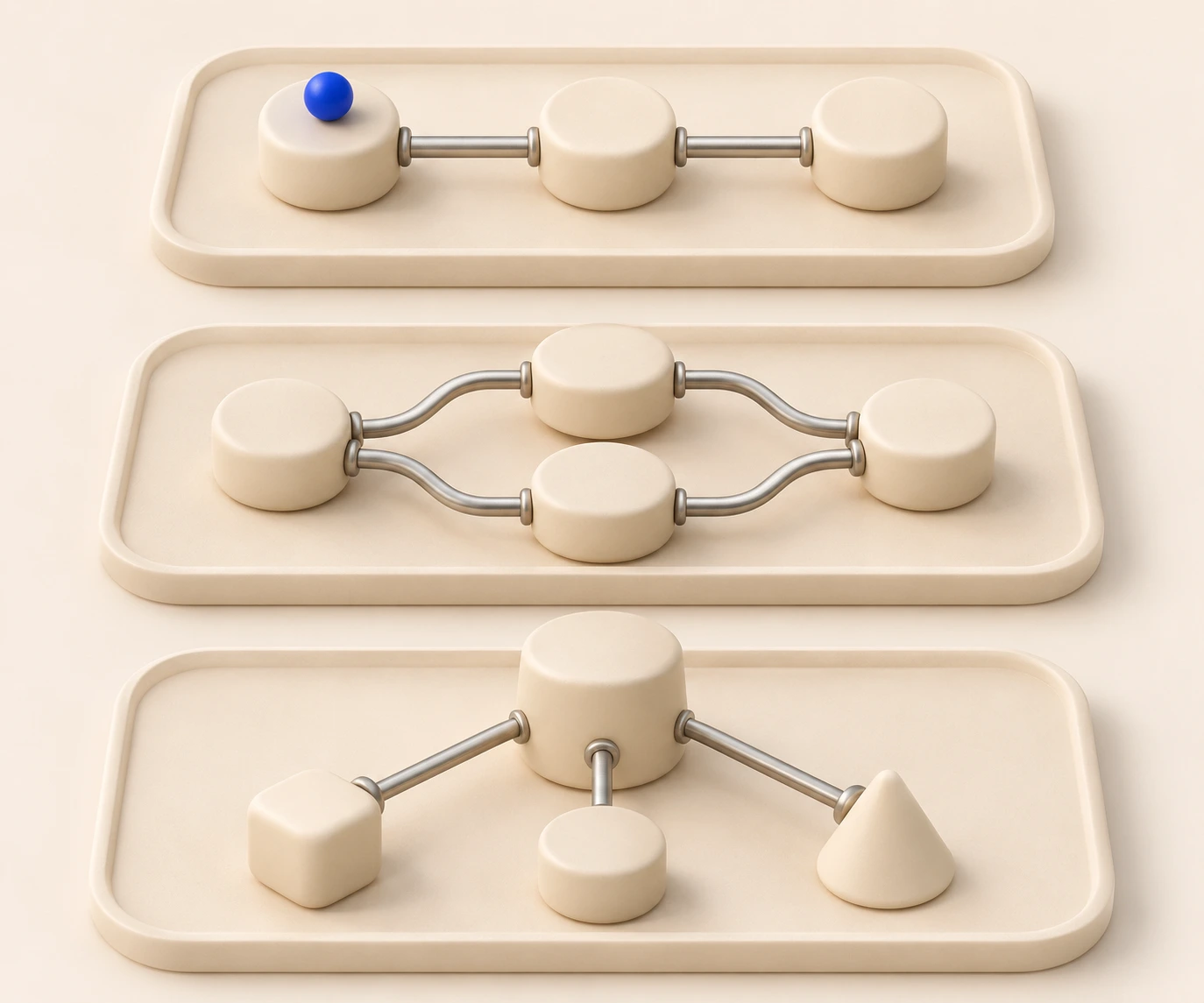
Choose the pattern from how the steps depend on each other, not from which framework is fashionable. Three shapes cover most production systems, plus a handoff variant.
Sequential
Each agent uses the previous agent's output: extract, then classify, then draft, then check. It is the easiest to reason about and to trace. Its weakness is propagation: an early mistake flows downstream, and one stalled step stalls the run. Put validation at the handoff, before the next step builds on the output.
Parallel (concurrent)
Agents work from the same inputs and do not need each other's results: several reviewers on one pull request, or several retrieval strategies on one question. Someone has to own reconciliation, either a deterministic merge or a designated agent. Parallel branches fail when they collide on shared files or quietly answer different questions, so give each branch an isolated sandbox and a scoped brief.
Supervisor (manager-led)
A manager agent routes work as findings come in, which suits tasks where the path cannot be planned up front, such as debugging an unfamiliar repository. It is the most flexible and the hardest to bound, so it needs explicit stop conditions, budgets per run and a cap on delegation depth.
Handoff and group chat
Frameworks such as Microsoft Agent Framework also describe handoff chains, where one agent passes control to a specialist, and group chat, where several agents contribute to a shared thread. Handoff fits support and triage flows with clear specialties. Group chat suits review and brainstorming, and can use more tokens when agents repeatedly receive shared history.
| Workload | Pattern | Guardrail to add |
|---|---|---|
| ETL-style document processing | Sequential | Schema validation at every handoff |
| Multi-angle code or content review | Parallel | One reconciliation owner, isolated sandboxes |
| Open-ended debugging or research | Supervisor | Step budget, delegation depth cap |
| Customer triage with specialists | Handoff | Explicit escalation to a human |
A useful default: start with one agent, move to sequential when a step needs a different capability, and add parallelism only when you can name the reconciliation owner.
Integrating multiple models and providers
Once the pattern is set, the next decision is which model serves each step. Hard-coding one provider couples your product to that provider's pricing, outages and rate limits. The alternative is a routing policy that classifies each request and picks a target.
The SEAR paper describes one such approach: a lightweight model classifies task type, complexity and domain for each incoming request and looks up a matching policy in a queryable layer of evaluation signals. For provider selection, it keeps providers whose quality is within 5% of the best and ranks them by median time to first token. The same paper observes that one model can behave differently across providers because of differing serving setups, which is why provider choice belongs in the routing policy and not in a constant.
For agents, the same logic extends one level up. The choice is not only "which model" but "which harness, which skills and tools, which memory and which sandbox." HarnessRouter supports multiple harnesses, including Codex, Claude Code, Hermes, DeepSeek Harness in developer preview and Pi, behind one API, with agent session management, file handling, plugin support and environment provisioning. Because it is built on the open UHP, you can change supported, compatible harness and model configurations for a task without rewriting the integration. If you are exposing agents inside a product, the AI agent API guide shows the product-facing surface, and individual pages such as the Continue, QwenPaw and pool harnesses provide catalog reference information; consult the current models documentation and API catalogs for executable integrations.

What drives cost, and how routing reduces it
Agent cost has four drivers: tokens per step, number of steps, the price of the model chosen for each step, and the idle cost of environments and memory. Model selection per step is one documented cost lever in the studies below.
Two academic results are worth knowing:
- Per-step selection. The EvoRoute paper describes a system that selects Pareto-optimal model backbones at each step, balancing accuracy, efficiency and resource use, and refines its policy from environment feedback. On agentic benchmarks such as GAIA and BrowseComp+, it reduces execution cost by up to 80% and latency by over 70%.
- Production traffic. In the SEAR evaluation of gateway routing, one organization's simple-complexity slice was served best by a lighter model that cost 90% less on input tokens and 92% less on output tokens than the deployed baseline. A 100-session replay showed effectively tied quality, with a tie-adjusted win rate of 48% for the routed model and 72 ties.
The lesson is that agent traffic can mix hard and simple steps, and paying frontier-model prices for the simple ones can waste money when a cheaper model meets the same quality requirements. Routing by task complexity, with quality signals you measure on your own traffic, captures that saving. Our own claim is that HarnessRouter is designed to cut agent costs by over 90%, by letting teams benchmark and configure compatible harness, model and module choices per task for quality, latency or cost. Validate that claim on your own workload. For the full playbook, see our LLM cost optimization guide.
A short worked example shows the arithmetic. Suppose a pipeline runs a classification step and a drafting step per request. If the classification step moves from a model priced at $1.00 per million input tokens to one priced 90% lower, that input line falls from $1.00 to $0.10 per million tokens. The drafting step stays on the stronger model. The saving is concentrated where quality was never the constraint, which is the pattern the SEAR slice illustrates.
Observability, reliability and human oversight
Multi-agent systems fail in ways single calls do not: a bad handoff, a looping supervisor, a tool call that silently returns nothing. One analysis reports that studies of 1,600+ execution traces across seven orchestration frameworks reported failure rates of 41% to 86.7% in the evaluated benchmark setups, and recommends OpenTelemetry-based distributed tracing with parent-child spans that mirror the delegation structure.
Whatever the exact rate in your system, the practice is sound:
- Trace delegation as a tree. Every sub-agent call is a child span of the step that spawned it, carrying model, harness, token counts and latency.
- Record state at each handoff. Reproducing a failure requires permitted input context or references to it, with redaction, access controls and retention limits for sensitive data.
- Set budgets and stop conditions. Cap steps, tokens and wall-clock time per run.
- Gate by consequence. Let reversible actions such as reading data or drafting content run autonomously, and require approval for irreversible or high-consequence ones such as external communication, production data changes or financial commitments. Pre-stage the context so the reviewer can approve quickly.
Our AI agent observability guide lists what to trace, measure and audit. On HarnessRouter Cloud, tracing is in beta and included with Scale; current add-on terms are on the pricing page.
Perspective
Most teams we talk to about orchestration start with a model router and discover that the model was never the only variable. The harness decides how tools are called, how files are handled and how a session resumes, and those details can change both quality and cost alongside the model.
That is why we built HarnessRouter around the harness as a first-class, swappable layer. When compatible, supported harnesses, models, providers, skills, tools, plugins, memory and sandboxes are configurable modules behind one interface, teams can use benchmarks to choose configurations per task for quality, latency or cost and run tasks in an isolated sandbox.
We also believe the harness layer should be open infrastructure. We initiated the Unified Harness Protocol so that no team has to commit to a single harness or vendor to get production-ready agents, and so that the interface you build against today still works as harnesses and models change.
Starting with HarnessRouter
HarnessRouter is an open-source unified interface and cloud platform for integrating, benchmarking and managing multiple agent harnesses in production through one API. Benchmarking tools let you compare harnesses and models on your own tasks before you commit a route, and the serverless agent runtime handles lifecycle features such as session management and environment provisioning.

The published cloud plans on the pricing page are Free at $0 per month, Developer at $20 per month, Production at $200 per month and Scale at $1,000 per month, with Enterprise on request. Bringing your own API keys carries a 0% BYOK routing fee up to $25,000 in monthly model usage at list prices, with a 5% routing fee above that volume. Agent work and memory remain separately billable. Top-up credits carry a 5.5% processing fee with a $0.80 minimum. If you prefer to run the stack yourself, the Community Edition is the open-source, self-hosted option.
FAQ
What is the difference between agent orchestration and a workflow engine?
A workflow engine executes a predefined, deterministic graph. Orchestration also covers decisions made at runtime, such as which agent or model takes the next step and whether to retry or escalate. Many teams combine them: the engine provides retries and recovery, and model-decided branches live inside individual steps.
Do I need multiple agents, or is one enough?
Start with one agent when it can produce a checkable result on its own. Add agents when a step needs a different capability, when branches can run independently, or when scope grows beyond what one agent can verify. Even a single agent needs sequencing, a retry policy and termination conditions.
How much can model routing reduce agent costs?
Published results vary with the workload. EvoRoute reports up to 80% lower execution cost on agentic benchmarks, and the SEAR study found a lighter model with 90% lower input and 92% lower output token cost on a simple-complexity slice, with effectively tied quality in a replay. Our platform is designed to cut agent costs by over 90%; validate that claim on your own workload.
How do I keep humans in control of autonomous agents?
Classify actions by reversibility and consequence. Reading and drafting can run autonomously, while external messages, production data changes and financial commitments go through an approval gate with the context prepared in advance. Pair this with step budgets and full tracing of every delegation.
Sources
- What Is Agent Orchestration, Arize AI
- AI Agent Orchestration Explained, JetBrains
- SEAR: LLM gateway routing paper, arXiv 2603.26728
- EvoRoute: Experience-Driven Self-Routing LLM Agent Systems, arXiv
- The Control Plane Problem: Why Multi-Agent AI Systems Keep Breaking
- Multi-Agent Orchestration on Azure: Workflow Patterns