
Infrastructure for AI agents is the set of runtime, state, tool-access, security and observability systems that sit between a model and your product, so that an agent can execute long, multi-step tasks reliably. A model API returns a completion. An agent needs somewhere to run code, a place to keep session state, controlled access to tools, a record of what it did, and a way to be stopped. This article describes each layer, explains how to deploy and operate them, and shows where a unified agent API reduces the amount of backend you build and maintain yourself.
TL;DR
- Agent infrastructure is an execution-time layer above the model and below the application: runtime, memory and state, tool access, evaluation, observability and guardrails.
- Production deployment typically means containerized, sandboxed runtimes, stateful sessions, least-privilege tool permissions, and step and resource budgets that prevent runaway loops.
- Tracing tool calls, token spend and latency is the baseline for diagnosing failures in non-deterministic agent runs.
- Cost control comes from benchmarking harnesses and models against your own tasks, routing by task, and choosing between self-hosted and managed operation.
- HarnessRouter exposes many agent harnesses through one Agent API, with an open-source Community Edition and a managed cloud.
What infrastructure for AI agents actually covers
Ordinary model-serving infrastructure optimizes individual inference calls: latency, throughput, GPU utilization. Agent infrastructure has a different unit of work. According to academic research on AI runtime infrastructure, the agent's execution trajectory becomes a first-class object, which the system monitors for state and corrects in real time. The same work describes this as an execution-time systems layer that operates above the model but below the application, optimizing for task success over long time horizons.
That definition has practical consequences. A single agent task may last minutes or hours, call dozens of tools, write files, spawn processes and resume after an interruption. Each of those behaviors needs infrastructure that a stateless request/response endpoint never required:
- A place to execute. Agents that edit files or run commands need an isolated environment, not the application server.
- Durable state. Session history, working files and memory must survive restarts and be addressable by a session identifier.
- Controlled tool access. Every tool is a permission boundary.
- A trace of the run. Without it, a failed trajectory cannot be diagnosed.
- Limits. Budgets for steps, tokens, time and compute.
The layers of an agent infrastructure stack
Published stack descriptions differ in naming but converge on the same responsibilities. The O'Reilly 2026 overview of the agents stack lists six: models and inference, protocols and tools, memory and knowledge, frameworks and SDKs, evaluation and observability, and guardrails and safety. Another breakdown of agentic architecture splits the stack into a reasoning core, orchestration and runtime, memory and state, knowledge and retrieval, tools and action, and an operational and governance plane.
For an engineering team deciding what to build, the following table maps those descriptions to concrete infrastructure responsibilities.
| Layer | What it does | What you must decide |
|---|---|---|
| Model and inference | Runs the underlying model | Which providers and models, and whether to bring your own API keys |
| Agent runtime (harness) | Runs the loop of reasoning, tool calls and file edits | Which harness fits the task, and how it is isolated |
| Memory and state | Stores sessions, files and long-term memory | Retention, size limits, per-tenant isolation |
| Tools and protocols | Connects the agent to APIs, data and other agents | Which protocols, which permissions, which tools are trusted |
| Orchestration and scaling | Starts, pauses, resumes and replicates agent runs | Concurrency, queueing, step budgets |
| Evaluation and observability | Traces runs and measures quality | Trace schema, evaluation datasets, alerting |
| Guardrails and governance | Authorizes actions and validates outputs | Policies, human approval for high-risk actions |
Security and observability are not a final stage. They cut across every row, which is why teams that add them late tend to rebuild the runtime. HarnessRouter's own write-ups on the seven layers of the AI agent stack and on the agent harness layer go deeper on where the harness fits.
The harness is the layer teams underestimate
The harness is the program that wraps a model with its tool loop, prompts, file handling and permission model. Codex, Claude Code and similar agents are harnesses. Two harnesses running the same model can behave very differently on the same task, which means the harness is a variable to be tested, not a fixed choice. Treating it as a swappable component is the central idea behind agent portability.
How to deploy and manage agent infrastructure
A practical guide to designing, developing and deploying agents recommends containerized environments managed by an orchestration platform such as Kubernetes to handle scaling and resilience. The same guide specifies that the infrastructure should manage stateful sessions for persistent memory, expose tools through sandboxed connections, and enforce granular policies for identity and data access at runtime. Scaling is handled by spinning up replicas on load while enforcing step budgets and resource limits to prevent runaways.
Translated into a working sequence:
- Define the unit of isolation. One sandbox per session is the common baseline, so that one tenant's files and processes are never visible to another.
- Make sessions durable. Persist conversation history and the working directory behind a session ID so a run can pause and resume.
- Put limits in the runtime, not the prompt. Maximum steps, wall-clock time, token spend and memory per run are enforced by the platform, because a prompt instruction can be ignored by the model.
- Expose tools through a narrow gateway. Each tool gets the least privilege it needs.
- Instrument before launch. Capture traces from the first prototype, not after the first incident.
- Scale horizontally. Treat each session as an independent, resumable job.
Building these six pieces yourself is feasible, and many teams do. The question is whether it is the part of the product that differentiates you. The comparison of building sandboxing yourself or getting it bundled covers that trade-off for the isolation layer specifically, and the overview of what a complete backend for AI agents includes lists the surrounding components.
Integrating multiple models and agent harnesses
Product teams rarely stay on one agent. A coding task may suit one harness, a research task another, and a cost-sensitive background job a third running a cheaper model. Without an abstraction layer, each harness brings its own SDK, authentication, event format, file handling and session model, and your application accumulates one adapter per agent.
There are three ways teams handle this:
- Direct SDK integration per agent. Maximum control, but the adapter code and its maintenance grow linearly with each harness.
- A framework that wraps model calls. Useful for orchestrating models, but it does not run the agent's sandbox, files or lifecycle for you.
- A unified agent API. One request format, one session model and one event stream, with the harness selected by a parameter.
Open standards reduce the lock-in in any of these. The overview of agent protocols in 2026 compares MCP, A2A, AG-UI and the Unified Harness Protocol, which addresses the harness layer specifically. For choosing which agent to start with on code-centric work, see the ranking of AI coding agents by task and evidence. For a clear distinction between vendor SDKs, hosted agents and command-line agents, see the comparison of Agent SDKs, managed agents and Agent CLIs.
What managed agent infrastructure includes
Managed agent infrastructure moves the runtime, scaling and lifecycle work to a provider while your product keeps the user experience, the business logic and the data policy. A complete managed offering typically covers:
- Provisioning of isolated environments per session
- Session storage and file handling
- Plugin and tool configuration
- Routing to model providers, with or without your own keys
- Tracing and usage metering
- Lifecycle management, including starting, suspending and tearing down serverless agent runtimes
Responsibilities that remain with your team are not removed by managing the infrastructure. You still define which tools an agent may call, what data it may reach, which actions require human approval, and which evaluation criteria count as success. You also decide your data retention and compliance posture. A managed platform gives you the controls to express those decisions; it does not make them for you. The practical trade-offs are therefore about control and operations: a self-hosted deployment gives you the full environment and its upkeep, a managed cloud gives you less to operate in exchange for usage-based billing.
Security, tool permissions and monitoring
Tool access and sandboxing
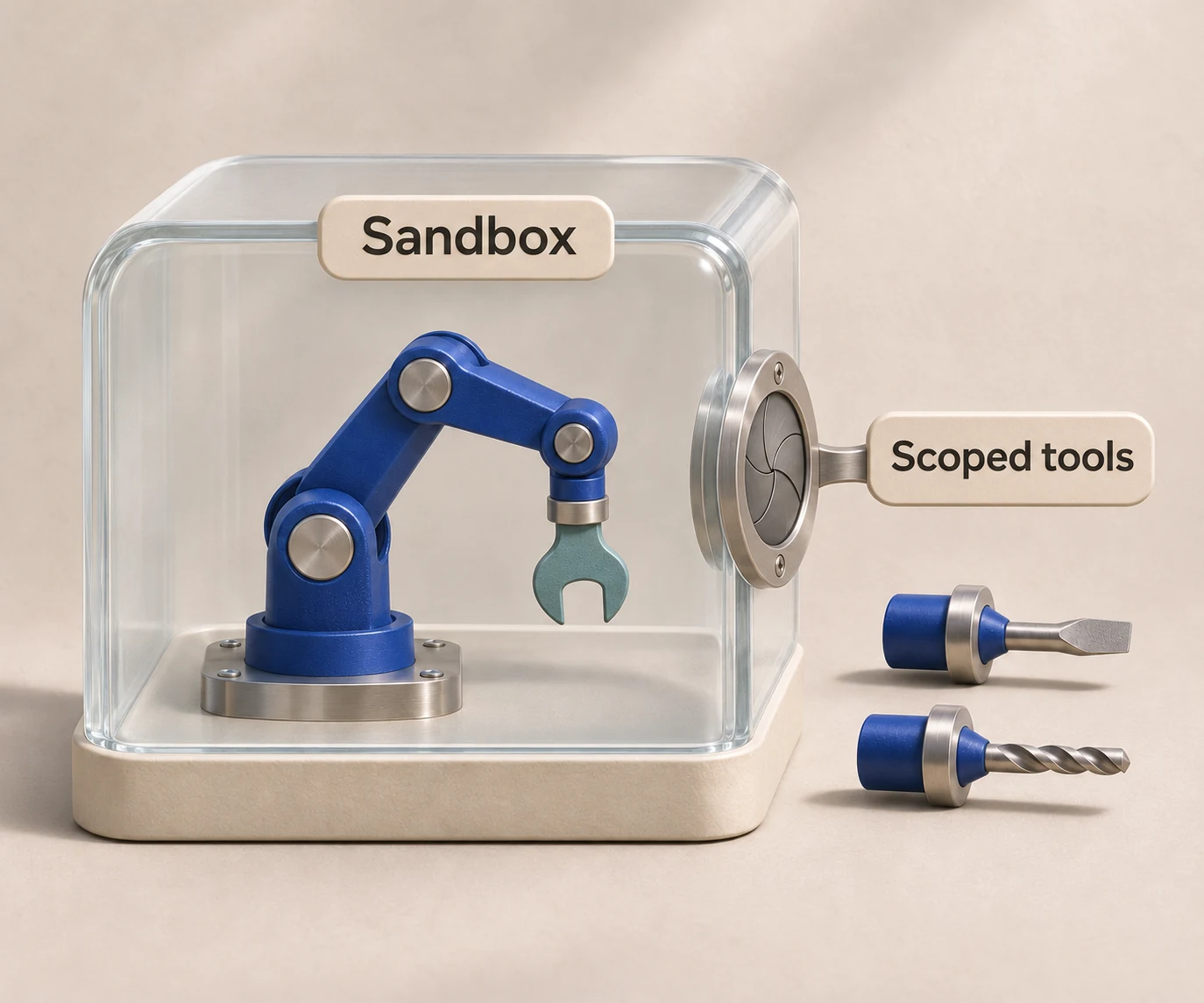
Every external tool is an attack surface. The OWASP guide to securely using third-party MCP servers calls for sandboxing, least-privilege policies and verification of tool manifests to prevent tool poisoning and indirect prompt injection. It also lists automated scanners such as MCP-Scan, Semgrep MCP Scanner and mcp-watch for checking tool descriptions, dependencies and vulnerabilities. Run untrusted tools in an environment where a compromised tool can reach only what you have explicitly granted.
A description of production agent architecture adds operational controls: bounded loops, least-privilege tools, and human oversight for high-risk actions. Define the high-risk set in writing before launch: payments, deletions, outbound messages and production deployments are typical members.
Observability and failure diagnosis
Agent failures are rarely a single error. They are a chain of plausible steps that ends in a wrong result, so diagnosis requires the whole trace: each tool call, its inputs and outputs, token spend and latency per step. The OpenTelemetry project's work on AI agent observability aims to standardize semantic conventions so telemetry is consistent across frameworks and not tied to a vendor-specific format. Adopting an OpenTelemetry-compatible trace schema early keeps your options open if you change tooling.
Evaluation
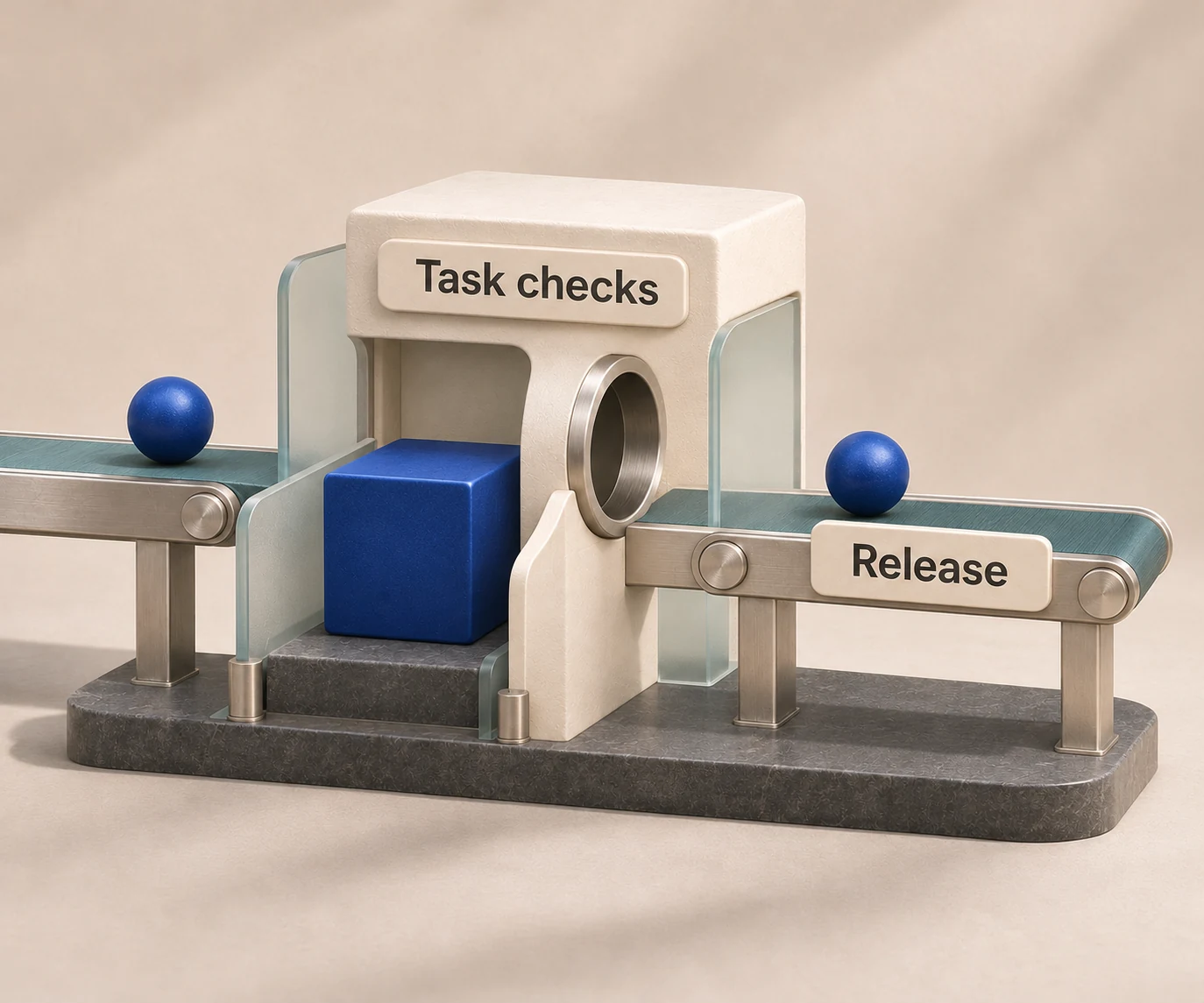
Because agent output is non-deterministic, manual spot checks miss regressions. The same architecture description points to evaluation frameworks, often using LLM-as-judge techniques, to pin quality and surface regressions. A workable practice is a fixed set of representative tasks that every change to a prompt, harness or model must pass before release.
Organizations that deploy agents across clients, such as agencies, often start from the productivity case before governance; AI productivity results for agencies illustrate what teams measure, and the governance controls above determine whether those gains hold up in production.
Controlling operating costs without losing reliability
Agent costs have four sources: model tokens, compute for the runtime, storage for state, and the observability pipeline. Four practices keep them predictable.
- Benchmark harnesses and models on your own tasks. Quality and price differ by harness and by model, and the cheapest combination that clears your quality bar is usually not the default one. Compare cost per successfully completed task, not cost per token.
- Route by task. Send simple, high-volume tasks to smaller models and reserve expensive ones for work that needs them. See the per-model pricing pages, for example claude-haiku-4.5 and gemini-3.1-pro-preview, when comparing model costs.
- Enforce budgets in the runtime. Step limits, timeouts and token ceilings stop a looping agent from turning into a bill.
- Suspend idle sessions. Serverless runtime lifecycles mean you pay for active work, not for sandboxes waiting for a user.
Reading the HarnessRouter pricing model
Pricing on HarnessRouter is published on the pricing page. Plans are Free at $0 per month, Developer at $20 per month, Production at $200 per month and Scale at $1,000 per month, with Enterprise priced on request. Additional line items include tracing at $50 per month, agent memory (Beta) at $0.0000840 per hour per GB, a 5.5% processing fee on top-up credit. When you bring your own API keys, routing is fee-free up to $25,000 per month of model usage at listed prices, with a 5% routing fee above that volume. Agent work is billed on usage. Check the page for the current terms before you budget, since plans and fees can change.
Our perspective
We built HarnessRouter on one observation: the hard part of shipping an agent-powered product is rarely the model call. It is everything around it. Sessions, files, sandboxes, plugins, provisioning, tracing and lifecycle all have to work before the first customer trusts the product, and each agent harness brings its own version of every one of them.
Our position is that the harness should be a swappable component behind one Agent API. That is why HarnessRouter supports a growing set of harnesses, including Codex, Claude Code, Hermes, DeepSeek and Pi, through a single interface, and supports open standards such as the Unified Harness Protocol. A team that can change the harness with a parameter can benchmark honestly, pick the best fit for quality and price, and avoid lock-in to any single agent.
We also think the choice between self-hosted and managed should not be a one-way door. The Community Edition is open source, so you can run the same interface in your own environment. HarnessRouter Cloud offers the managed path, and we aim to apply no markup on model provider costs. Start where your constraints are, and move when they change.
Run agent infrastructure through one API
If you are building an agent-powered product and would rather spend engineering time on the product than on per-agent backends, HarnessRouter provides the runtime, sessions, files, plugins, environment provisioning and benchmarking behind one Agent API. Start on the Free plan to test a harness against your own tasks, then move to a paid plan as usage grows.

Teams that prefer to operate their own environment can use the Community Edition, and those ready to compare plans can open the pricing page. The [HarnessRouter home page](/) shows the supported harnesses.
FAQ
What is the difference between AI infrastructure and infrastructure for AI agents?
AI infrastructure generally serves model training and inference: compute, data pipelines and serving endpoints. Agent infrastructure sits above that and manages the execution of multi-step tasks: sandboxes, session state, tool access, tracing and guardrails. Research on runtime infrastructure describes it as a layer that treats the whole execution trajectory, not a single inference call, as the object to manage.
Do I need Kubernetes to run AI agents in production?
Not necessarily, but you need the properties it provides: isolated containers, scaling on load and resilience to failure. The deployment guide cited above recommends containerized environments under an orchestration platform. A managed agent platform supplies those properties without you operating the cluster yourself.
How do I monitor an agent that behaves differently on each run?
Capture a full trace of every run: tool calls, token spend and latency per step. Pair it with a fixed evaluation set so you can detect regressions. Following OpenTelemetry conventions keeps your telemetry portable across tools.
Can I switch agent harnesses without rewriting my application?
Yes, if your application talks to an abstraction rather than to each harness directly. With a unified Agent API, the harness is selected per request, which lets you benchmark alternatives and change your default without changing integration code.
Sources
- AI Runtime Infrastructure (arXiv)
- The AI Agents Stack, 2026 Edition (O'Reilly)
- Agentic AI architecture: the components and layers
- A Practical Guide for Designing, Developing, and Deploying Production-Grade Agentic AI Workflows (arXiv)
- A Practical Guide for Securely Using Third-Party MCP Servers (OWASP)
- AI Agent Observability: Evolving Standards and Best Practices (OpenTelemetry)
- AI for agencies: productivity results