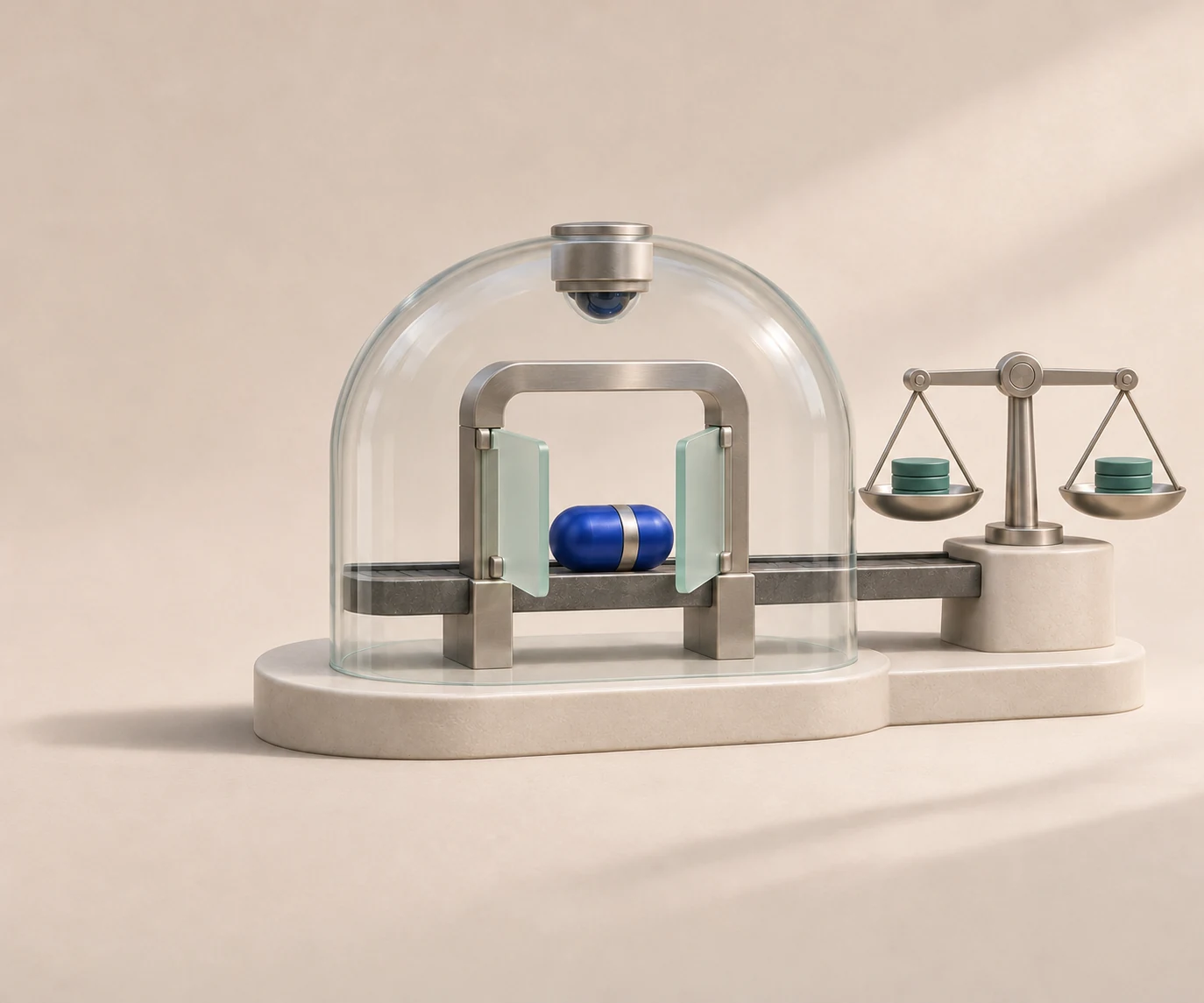
TL;DR
An AI agent in production is a system in which a model chooses tools and next steps on behalf of real users, under uptime, security, cost and quality constraints that a demo never faces. The model is the smaller part of the work. Most of the engineering goes into session management, sandboxed execution, permissions, tracing, evaluation and a backend that keeps working when the model underneath changes. This guide covers how production differs from a prototype, how to decide whether a problem needs an agent at all, which controls to put in place before launch, how to measure quality, and how to reason about operating cost.
- Production agents face adversarial and unexpected input, round-the-clock availability, logging and evaluation gates, none of which a demo exercises.
- Use an agent only when the process is open-ended; prefer a deterministic workflow when rules are stable and auditability matters.
- Deployment, monitoring, correction and rollback should not depend on which model sits underneath, and every plausible failure needs a pre-written response.
- Survey data points to observability and governance, not model capability, as the main limits on scaling agents.
- Cost control starts with per-task measurement, budget limits and tracing, and a unified agent backend reduces the engineering you carry yourself.
What separates a production agent from a demo
A demo is a controlled run. According to Addy Osmani’s analysis of the prototype-to-production gap, presenters know which inputs work, avoid edge cases, retry failures off-screen and show the best example. Production users misspell words, use slang or unexpected languages, ask unsupported questions, send very long or very short inputs, repeat queries and find failure modes nobody anticipated.
The same analysis lists what production demands in practice:
- Capacity for hundreds or thousands of real users, including adversarial input.
- Availability around the clock, with graceful degradation instead of hard failure.
- Fast responses for simple queries and consistent quality across inputs.
- Guardrails, monitoring, structured logs and traces.
- CI/CD pipelines with evaluation gates.
A scripted workflow differs in a different way. It follows a fixed path, so its failures are predictable and its behavior is easy to audit. An agent decides its own path, which is what makes it useful for open-ended work and also what makes its failures harder to enumerate. Treat these as two tools, not two maturity levels.
Deciding whether the problem needs an agent
The cheapest production agent is the one you did not need. Giuseppe Turitto’s pattern-selection guide frames the choice as a decision table.
| Signal | Prefer a workflow | Prefer an agent |
|---|---|---|
| Process shape | Stable, well understood | Open-ended |
| Correctness | Depends on deterministic rules | Missing information must be discovered |
| Tool selection | Known in advance | Depends on intermediate observations |
| Number of steps | Fixed | Unknown |
| Cost and latency | Must stay low | Tolerates variable cost |
| Auditability | Must be easy to audit | Traces provide the audit trail |
| Failure modes | Operators need predictable ones | Bounded by guardrails and review |
A fixed workflow that would branch into an unmaintainable tree is also a signal for an agent. In many products the answer is a hybrid: deterministic orchestration around the steps that must be exact, and an agent inside the step that needs judgment. A production engineering lifecycle for agentic workflows follows the same logic, redesigning the process first and automating only the parts that benefit.
Architecture for integrating models, tools and agent components
A practical guide on arXiv for designing, developing and deploying production-grade agentic workflows describes a lifecycle that includes workflow decomposition, multi-agent design patterns, the Model Context Protocol (MCP), tool integration, deterministic orchestration, Responsible-AI considerations and environment-aware deployment, and it distills these into nine best practices. It also lists the problems that appear when a prototype scales: multi-agent communication, heterogeneous models, secure tool access, failures and retries, logging, cost efficiency, monitoring, reproducibility, containerization, versioning and continuous delivery.
In practical terms, a production agent needs these layers beyond the model call:
- Agent harness. The loop that gives a model tools, context and a working environment. Different harnesses behave differently even on the same model, which is explored in why the same model feels different across products.
- Execution environment. An isolated sandbox with files, packages and network rules per session. The build-or-bundle tradeoff is covered in our note on agent sandboxing.
- Session and file storage. State that survives restarts, so a long-running task can resume.
- Tool and plugin layer. Controlled access to external systems, with scoped credentials.
- Observability. Traces of every step, tool call and cost event.
- Evaluation and benchmarking. A repeatable way to compare harnesses and models on your own tasks.
A fuller breakdown of these pieces appears in what a complete backend for AI agents includes and in the seven-layer AI agent stack.
Controls to put in place before launch
The changegamer.ai production-readiness checklist defines readiness in two parts: deployment, monitoring, correction and rollback must not depend on which model sits underneath, and every plausible failure needs a pre-written response before it happens. The same page states that the EU AI Act (Article 14) and the NIST AI RMF both call for auditable human oversight of high-risk AI actions. If your product serves users in the EU, check how that article applies to your use case.
Turn those principles into a launch checklist:
- Permissions. Give each session the narrowest set of tools, files and network destinations that the task needs. Keep credentials outside the model’s context.
- Human oversight. Put approval steps on actions that are hard to reverse, such as payments, deletions, external messages and production code merges.
- Failure handling. Write the response for timeouts, tool errors, malformed output, provider outages and runaway loops. Set step and time limits per task.
- Budget limits. Cap spend per task, per user and per day, and decide in advance what the agent does when a cap is reached.
- Versioning. Version prompts, tool definitions, harness configuration and model selection so any release can be rolled back.
- Release gating. Block releases when evaluation results fall below a threshold, whatever the average looks like.
The last item has research behind it. An arXiv paper on governance readiness proposes an index built from four dimensions, Evaluation, Context, Compliance and Governance, with hard block conditions that cap the score and prevent a positive release verdict even when the aggregate looks acceptable. In its validation set of 10,000 evaluated turns across 1,000 sessions, the overall defect rate was 41.79%, a reminder that capability on a benchmark does not substitute for release checks on your own traffic.
Evaluating and monitoring a live agent
Monitoring tells you what a live agent is doing: every step, tool call and cost event, captured as traces you can inspect after the fact.
Quality is the harder part, and it needs a defined regime. UST advises that AI products have evaluation regimes before they scale, measuring task success, hallucination tolerance, failure modes, refusal behavior, latency, safety and cost, and rerunning those measures whenever prompts, models, tools or knowledge sources change.
A workable monitoring set for a production agent:
| Signal | What to record | Why it matters |
|---|---|---|
| Task success | Outcome per task against a rubric or test | Primary quality measure |
| Steps per task | Count of model and tool calls | Early sign of loops and drift |
| Tool errors | Failure rate per tool | Separates tool faults from model faults |
| Latency | Time to first response and to completion | User-facing reliability |
| Cost per task | Tokens, compute and memory by session | Detects cost inversion |
| Human interventions | Approvals, edits, rejections | Trust and scope signal |
Keep a regression set of real, anonymized tasks and replay it whenever you change a harness or model. This is also the cleanest way to answer the question of which harness fits your product, which is the idea behind benchmarking harnesses side by side on the same inputs.
How agents fail after launch
Published post-mortems are scarce, so treat each one as a data point. One engineering team reported pushing four agents to production in 2026, of which only one survived 90 days. The failure patterns they describe are context drift (applying an old distribution to a new reality), cost inversion (cost per task exceeding the value added) and trust collapse after two confident wrong actions. The survivor was a code-review summary agent that was bounded, kept a human on the decision, made errors cheap and visible, and received fast correction signals.
That profile is a useful design template: narrow scope, a human at the decision point, visible errors and a short feedback loop.
Adoption data supports the picture of rapid scaling with governance as the constraint. A survey of 290 enterprise technology leaders reported production agent deployment rising from 19% to 54% in the first half of 2026, with observability and governance, not capability, as the gating factors for expansion. A late-2025 survey of more than 500 US technical leaders found that 57% of organizations deploy agents for multi-stage workflows, 86% have moved to AI coding agents for production code, and 80% report measurable economic returns.
Operating costs and how to control them
Production agent cost has several components, and each needs its own meter:
- Model usage. Input and output tokens per task, which grow with the number of steps and the size of the context.
- Execution compute. The runtime and sandbox time a task consumes.
- State. Memory and storage kept for sessions between runs.
- Observability. Tracing and log retention.
- Platform fees. Subscription, routing and payment processing charges.
Control comes from measurement before optimization. Record cost per completed task, not cost per request, and compare it with the value of the task. The cost inversion pattern above appears exactly when teams track the first number and ignore the second. Then apply limits: maximum steps, maximum spend per task, and a rule for escalating to a human when a limit is hit.
The model choice is the largest lever, and it is not fixed. Harness and model combinations differ in quality and price for the same task, so a repeatable benchmark on your own inputs usually finds a cheaper configuration that meets your quality bar. Keeping the integration behind one interface is what makes that swap a configuration change instead of a rewrite. The concept is described in what AI agent portability means.
Our perspective
Most teams that struggle with agents in production did not struggle with the model. They struggled with everything around it: where the agent runs, how its state persists, how its tools are scoped, and how to swap one harness for another without rebuilding the product.
We built HarnessRouter around that observation. It is an open-source unified interface that lets a product team plug Codex, Claude Code, Hermes and other supported agent harnesses into an application through one Agent API, so there is no separate agent backend to maintain for each. The API covers task execution, progress streaming, sessions and files, cancellation, errors and results. HarnessRouter Cloud adds serverless execution in isolated sandboxes and execution traces for comparing harness and model combinations.
Our position is that the harness should be a choice you can revisit, not a commitment you inherit. When a new harness or model improves quality or lowers cost on your tasks, you should be able to benchmark it and switch with configuration. We support open standards such as the Unified Harness Protocol, and offer both self-hosted and managed options.
That is why we treat production readiness as a property of the backend, not of the model: the integration, the API contract and the execution traces stay the same while the harness or model underneath changes.
Run agent harnesses in your product
If you are building an agent-powered product, HarnessRouter gives you one API for Codex, Claude Code, Hermes and other supported agent harnesses, with managed HarnessRouter Cloud plans and an open-source edition for self-hosting. You can compare plans on the pricing page or start from the [HarnessRouter homepage](/).
Teams that prefer to run their own infrastructure can start with the Community Edition, and teams comparing integration approaches can read about agent SDKs, managed agents, agent CLIs and HarnessRouter.
Sources
- Lesson 11: from prototype to production, Addy Osmani
- Choosing the Right Pattern, Agentic Systems Patterns
- A Practical Guide for Designing, Developing, and Deploying Production-Grade Agentic AI Workflows
- Stop Shipping AI Agents on Faith
- Shipping AI Agents to Production: A Production-Readiness Checklist
- AI Center of Excellence: From Experimentation to Enterprise Value, UST
- We Pushed 4 AI Agents to Production in 2026
- Enterprise AI Agents in Production: Mid-Year 2026 Market Report
- The 2026 State of AI Agents Report
- Redesign, Don’t Automate: AI Workflow Automation
FAQ
FAQ
- What does it mean to run an AI agent in production?
- It means real users depend on the agent, and it must handle unexpected input, stay available, and produce consistent results while being logged, traced and evaluated. A demo only needs to work once on a chosen example.
- When should I use an agent instead of a workflow?
- Use an agent when the process is open-ended, the number of steps is unknown, or tool choice depends on what the agent observes along the way. Use a workflow when rules are stable, correctness is deterministic and the system must be easy to audit.
- What should be in place before the first release?
- Scoped permissions, human approval for irreversible actions, pre-written responses for likely failures, budget and step limits, versioned prompts and configuration, and an evaluation set that gates each release. Rollback should work regardless of which model is in use.
- How do I keep agent costs under control?
- Measure cost per completed task, cap spend and steps, trace every run, and benchmark alternative harness and model combinations on your own tasks. A single integration layer makes it practical to switch to the configuration that meets your quality bar at a lower price.