

Quick answer
What managed agents are
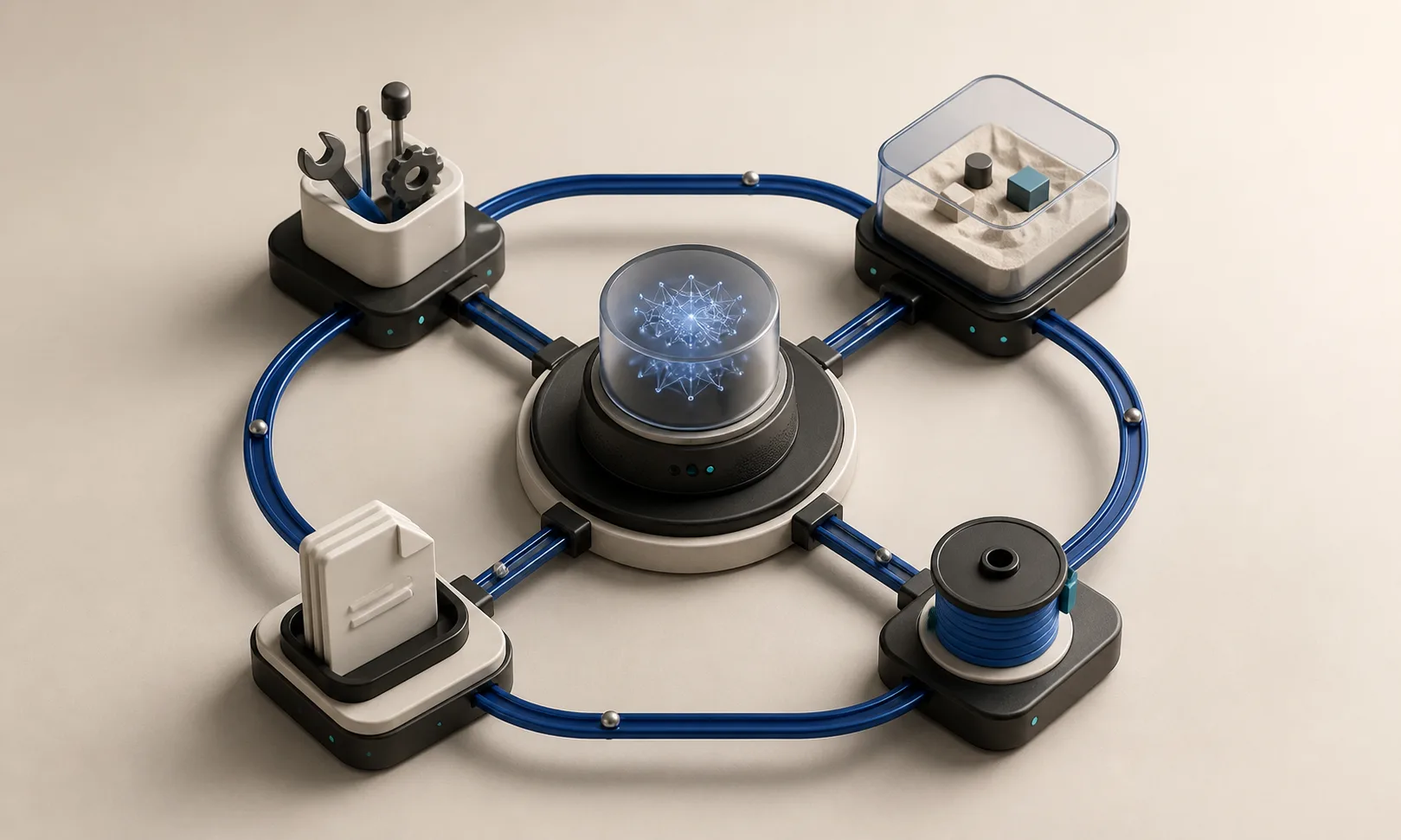
Managed agents are AI agents that run on infrastructure a vendor operates for you: the vendor hosts the agent loop, sessions, and state, and your product talks to them through an API. Where the sandbox runs varies by product.
AWS got here first: Agents for Amazon Bedrock went generally available in November 2023, and Amazon Bedrock AgentCore followed in 2025. In 2026 the term sharpened through two more launches: Anthropic shipped Claude Managed Agents into public beta in April, and Google previewed managed agents in the Gemini API at I/O in May. All three remove the same burden: you stop operating agent infrastructure and start consuming it.
The limits differ, and they matter before choosing: Anthropic and Google each run only their own vendor's agent stack, while AWS centers on agents you bring, plus a managed loop of its own. This page compares the three, then covers the multi-harness version of the same idea.
Option 1
Claude Managed Agents
Claude Managed Agents entered public beta on April 8, 2026 as a suite of REST APIs on the Claude Platform. Anthropic describes it as a fully managed agent harness for running Claude as an autonomous agent, with secure sandboxing, built-in tools, and streamed sessions. Pricing combines standard token rates with a session runtime charge of $0.08 per session hour, metered only while a session is running. It remains in beta as of August 2026.
Its strength is depth in one stack: if your product is committed to Anthropic models and the Claude agent loop, this is the vendor's own path to hosted execution.
The limitation is the flip side of that depth: sessions, state, and permissions follow Anthropic's formats, and every other harness is still a separate integration. One edge did loosen in May 2026: tool execution can now run in a self-hosted sandbox on your own infrastructure, while the agent loop and session state stay on Anthropic's side.
Option 2
Google's managed agents in the Gemini API
Google introduced managed agents in the Gemini API at I/O 2026, and they remain in public preview. Google's own description is direct: managed agents give you a configurable agent harness. A single API call provisions the Antigravity agent, which reasons, browses, and executes code in a hosted Linux sandbox, with files and state that persist across turns.
It is the same shape as Anthropic's offer: one vendor's agents, operated by that vendor. Models are Gemini only, and you cannot bring your own agent framework, though the base agent accepts custom instructions, skills, and MCP tools.
Option 3
Amazon Bedrock AgentCore: bring your agent, or use theirs
AWS got to this market before either launch above. Agents for Amazon Bedrock went generally available in November 2023, selling exactly this idea: configure an agent, and AWS operates it. AWS has since closed that product, now named Amazon Bedrock Agents Classic, to new customers, and points them to Amazon Bedrock AgentCore, which previewed in July 2025 and went generally available that October.
AgentCore stakes out a different position from the two options above. It is framework agnostic: you bring agent code written in LangGraph, CrewAI, Strands, or plain API calls, and AWS operates the runtime. In its default serverless mode, each session runs in its own isolated microVM, idle time is free, and billing is per second of active compute.
Since April 2026, AgentCore also offers a managed agent loop of its own, a component AWS calls Harness: declare a model, system prompt, and tools, and AWS runs the loop with no orchestration code. The main trade remains. AWS gives you the most freedom in what the agent is, and in return you still design and maintain most of what the agent does. Anthropic and Google hand you a finished agent, but only theirs.
The pattern
What all three leave out
All three offerings point at the same pain: operating sandboxes, sessions, and recovery logic is work product teams would rather not own. Anthropic pitches its version as replacing the agent loop, tool execution, and runtime you would otherwise build. Anthropic and Google built the managed layer for their own stack first; AWS built it around agents you bring.
Many products, though, face a multi-vendor question, because the harness that wins on one task class can lose on another. The landscape also keeps moving: new harnesses and major updates shipped month after month through 2026. Committing a backend to one vendor's managed offering solves the infrastructure burden but adds a new coupling: your sessions, state, and permissions now follow that vendor's formats.
And none of the three manages an existing harness across vendors. Anthropic's option runs Anthropic's agent, Google's runs Google's, and AWS runs agents built on its platform, not the harnesses the labs already ship with state-of-the-art agent behavior built in. That is the gap the multi-harness approach fills: someone operates the harness for you, but which harness stays your choice.
Option 4
The multi-harness approach
HarnessRouter is the world's first unified interface for agent harnesses and applies the managed-agents idea across vendors: it operates fifteen harnesses behind one contract, so the harness is a request parameter and switching setups is a configuration change.
Running several harnesses behind one interface is also what makes honest comparison practical: the same task, the same input, and the same contract can be pointed at different configurations, and the results can be measured against each other. Our same-task benchmark shows why that matters: in that test, six of eight configurations had an alternative that was both cheaper and faster.
Decision guide
How to choose
- All-in on Anthropic models and agent shapes: Claude Managed Agents is the native path.
- All-in on the Gemini stack: managed agents in the Gemini API are the native path.
- An agent you built yourself in LangGraph, CrewAI, or Strands, on a team already on AWS: AgentCore manages the runtime, and its Harness component can even run the loop.
- Multiple harnesses on the table, or a product that should outlive any single vendor decision: a multi-harness layer keeps the choice open.
- Whichever you pick, note the date you decided and recheck in a quarter: every offering on this page shipped or changed materially within the last five months.
FAQ
Managed agents: common questions
What are managed agents?
Managed agents are AI agents whose infrastructure a vendor operates for you: the vendor hosts the agent loop, sessions, and state, and your product interacts through an API instead of running that infrastructure itself. Sandbox placement varies; Claude's managed agents, for example, default to vendor-hosted sandboxes with a self-hosted option.
What is the difference between Claude Managed Agents and Google's managed agents?
They are the same pattern from two vendors. Claude Managed Agents (public beta since April 2026) hosts Anthropic's agent loop behind REST APIs with token plus session-runtime pricing. Google's managed agents in the Gemini API (public preview since I/O 2026) provision the Antigravity agent, which Google describes as a configurable agent harness, with a hosted sandbox and persistent state. Each operates only its own vendor's stack.
Is Amazon Bedrock AgentCore a managed agents product?
Yes, with a different split of responsibility. AgentCore, generally available since October 2025, manages the runtime for agents you build in frameworks such as LangGraph, CrewAI, or Strands: isolated sessions, memory, identity, and per-second billing, plus an optional managed loop AWS calls Harness. Claude and Google host their own vendor's agent instead, and a multi-harness layer such as HarnessRouter hosts existing harnesses like Codex and Claude Code.
Do managed agents lock me in?
Single-vendor managed agents couple your backend to that vendor's session, state, and permission formats. That is acceptable if you are committed to the stack. If you want the managed pattern without the single-vendor boundary, a multi-harness layer such as HarnessRouter keeps the harness as a request parameter.
Can I get managed agents for Codex and Claude Code through one API?
Yes. HarnessRouter operates fifteen harnesses as managed agent harnesses behind one contract covering the full task lifecycle, from task submission to reviewable artifacts.
The managed pattern, minus the vendor boundary
Run Codex, Claude Code, Hermes, Pi, DeepSeek Harness, OpenCode, Qwen Code, and Cline as managed agent harnesses through one API.
Start building free