

Quick answer
The AI agent stack turns physical capacity into customer outcomes
The AI agent stack is the chain of systems required to turn electricity, compute, and models into useful work for a customer.
The lower layers supply scarce physical capacity. The middle layers supply intelligence and execution. The upper layers combine that execution with a specific workflow, user experience, and business outcome.
This distinction matters because a model is only one part of an agent product. A model can reason about the next action, but it does not by itself manage tools, permissions, sessions, files, sandboxes, retries, or finished artifacts.
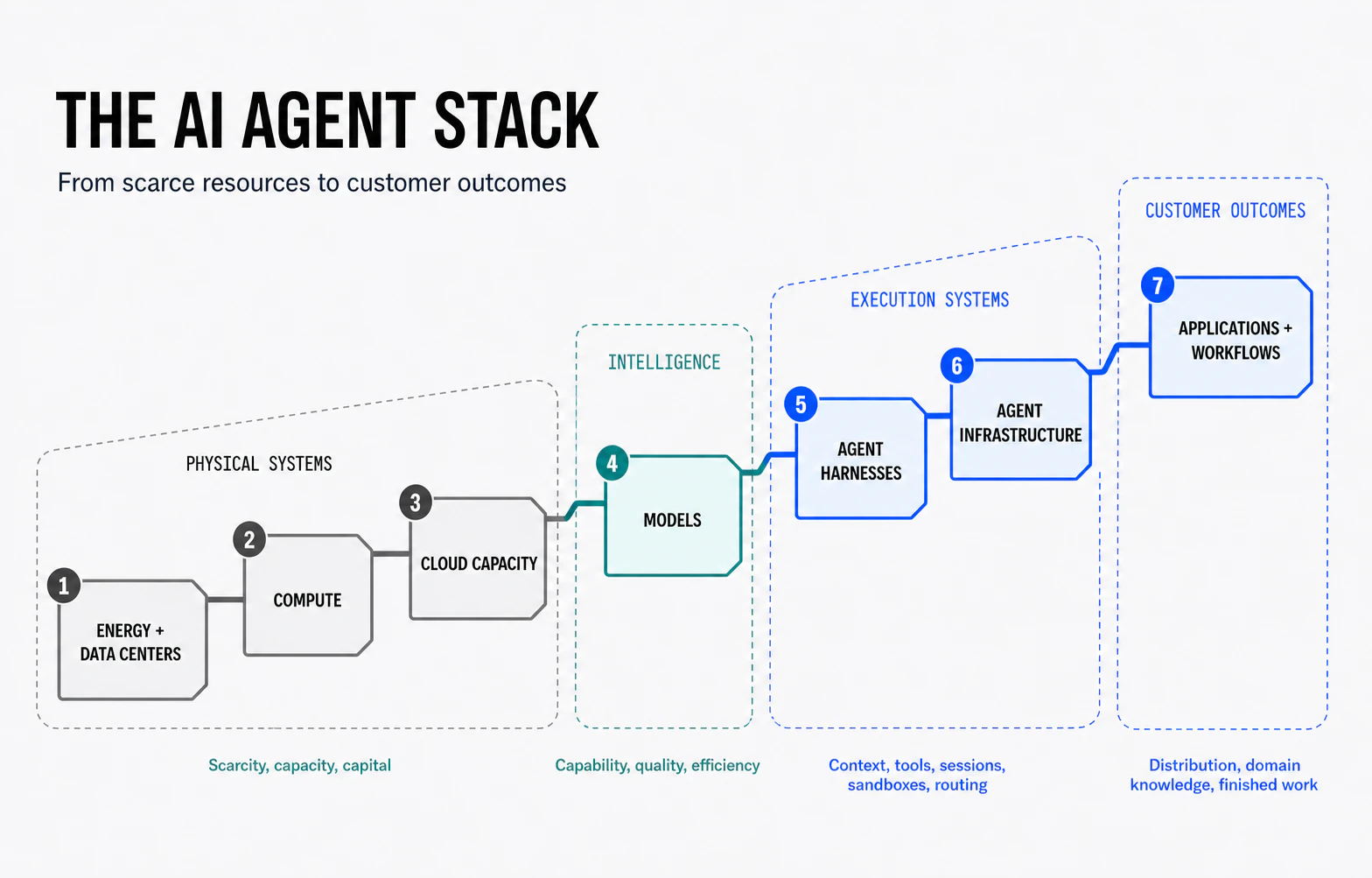
A practical agent stack therefore needs seven layers: energy and data centers, compute, cloud capacity, models, agent harnesses, agent infrastructure, and applications.
The economics of those layers are not the same. To see where durable value can form, start with the two forces acting on the stack.
Economics
Physical scarcity and customer specificity create value in different ways
At the bottom of the stack, value comes from constrained resources: power, energized data center capacity, advanced manufacturing, memory, networking, and capital. These resources take time and money to expand.
At the top, value comes from specificity. An application becomes useful when it understands a customer, fits a workflow, connects to the right systems, earns trust, and returns an outcome someone will pay for.
The middle of the stack connects these two economies. Models turn compute into intelligence. Harnesses turn intelligence into action. Agent infrastructure makes that action reliable enough to become a product capability.
This is why a simple margin curve from the bottom to the top can be misleading. Each layer has its own constraint, failure mode, and source of differentiation.
Layers 1–3
Energy, compute, and cloud capacity remain physical businesses
AI begins with electricity and a place to convert it into computation. Data centers need land, grid access or dedicated generation, cooling, networking, equipment, and long lead-time infrastructure. The International Energy Agency expects global data center electricity use to more than double by 2030, with AI as a major driver.
Above that sits compute: accelerators, memory, networking, packaging, interconnects, systems software, and manufacturing capacity. Building a general-purpose frontier accelerator is difficult for a startup, but the opportunity is broader than a single chip. Inference systems, memory, networking, cooling, compilers, and tightly integrated infrastructure can all remove bottlenecks.
Cloud capacity packages those resources into something developers can consume. Hyperscalers offer broad platforms and global reach. Specialized AI clouds can compete through accelerator access, cluster design, price, or workload focus. In both cases, economics depend on utilization, financing, energy, operations, and software, not demand alone.
These layers determine how much intelligence can be produced and at what cost. They do not determine which intelligence is best for every task.
Layer 4
Models are getting cheaper, but they are not interchangeable
The model layer converts compute into general capabilities such as reasoning, generation, perception, and tool use. Its economics are changing quickly. The Stanford AI Index reported that the cost of inference at an early GPT-3.5 level fell more than 280-fold between late 2022 and late 2024, while smaller and open models improved.
Falling cost does not mean every model becomes identical. Frontier capability, latency, context length, modalities, tool use, reliability, regional availability, and price still differ. Those differences also change from one release to the next.
The practical conclusion is not that models have no value. It is that product teams should avoid treating one model as a permanent architectural choice. The right model depends on the task and should be evaluated against real outcomes.
Once a model can choose an action, the next layer must give it a controlled way to act.
Layer 5
An agent harness turns model intelligence into action
A model proposes what to do. An agent harness provides the context, tools, instructions, permissions, and environment required to do it.
A harness can maintain the working context, expose tools and skills, run an execution loop, inspect results, recover from errors, and decide when a task is complete. Coding harnesses such as Codex, Claude Code, and Hermes combine these elements in different ways.
The harness matters because the same model can behave differently when its tools, prompts, context strategy, file access, and execution loop change. Measuring the model alone misses part of the system that produced the result.
This is also why enterprises cannot capture their operating knowledge by selecting a model alone. Policies, domain context, permissions, approval steps, and tool access have to be encoded around the model.
A harness can complete impressive work on its own. Turning that harness into a dependable backend for many product users requires another layer.
Layer 6
Agent infrastructure: the agent harness control plane
A product backend must manage more than a single agent loop. It needs task and run lifecycle, session continuity, streaming progress, isolated sandboxes, file inputs, structured artifacts, retries, traces, budgets, concurrency, and failure recovery.
It also needs portability. If an application integrates directly with one harness, its product objects and user experience can become coupled to that harness. Adding another harness then means rebuilding sessions, events, files, permissions, and rendering around a second runtime.
A shared agent infrastructure layer, the agent harness control plane in the diagram above, creates stable contracts above those runtimes. It lets a product compare complete harness × model combinations and route work using success, quality, latency, cost, policy, or task type.
This layer does not replace models or harnesses. It makes them usable as interchangeable, measurable components of a production system.
Layer 7
Applications still own the customer outcome
The application layer is not disappearing. It is changing from a collection of screens and manual workflows into an interface for delegating, reviewing, and continuing work.
Applications remain close to the customer. They can own distribution, workflow design, proprietary context, integrations, trust, approval boundaries, outcome data, and the system of record. Those assets are not supplied by a general model or harness.
Some existing software categories will be displaced. Others will expose their data and actions to agents. Many will become hybrid systems where people define goals and constraints while agents perform more of the execution.
The strongest vertical AI products will combine domain expertise with control over a real workflow. In physical industries, that may include robotics, laboratories, manufacturing, logistics, or other systems where software directly changes the world.
Customer proximity is valuable only when it produces a better outcome. A thin interface with no workflow ownership is still easy to replace.
Strategy
Where can durable value accrue in the AI agent stack?
No single layer owns all of the margin. Durable value tends to form where a company controls a real constraint or compounds proprietary learning.
- Physical scarcity: power, capacity, manufacturing, networking, and capital that cannot be expanded instantly.
- Capability frontier: intelligence or efficiency that materially changes which tasks are possible.
- Execution reliability: the ability to complete long-running work safely and consistently.
- Operational control: routing, policy, observability, cost management, and failure recovery across runtimes.
- Proprietary context: permissions, domain knowledge, data, tools, and feedback that improve task performance.
- Workflow ownership: a direct relationship with the customer and responsibility for the finished outcome.
The important question is therefore not which layer sounds most exciting. It is which scarce resource, control point, or feedback loop a product can actually own.
Builder playbook
Build for changing models and measurable agent outcomes
Most product teams do not need to own every layer. They do need to protect the parts of the stack that define their customer experience.
- Keep the application contract independent from any one model or agent harness.
- Evaluate models inside the harnesses and environments where they will actually run.
- Measure cost per successful task, not only price per token or price per request.
- Store traces, artifacts, failures, and user corrections so routing decisions can improve over time.
- Keep domain context and permissions close to the customer workflow that owns them.
- Treat sessions, files, sandboxes, streaming, and retries as product infrastructure, not demo glue.
This architecture lets a team adopt better models and harnesses as they appear without rebuilding the product around each one.
HarnessRouter
HarnessRouter is the control plane for the execution layer
HarnessRouter sits between AI applications and agent harnesses. A product sends a task through one API. HarnessRouter runs the selected harness in an isolated environment and returns consistent progress, files, traces, and structured artifacts.
Because the task contract stays stable, teams can compare Codex, Claude Code, Hermes, and future harnesses without rebuilding their product backend. They can evaluate complete model × harness combinations, then route each workload for quality, cost, latency, and reliability.
Models provide intelligence. Harnesses complete work. Applications own the customer outcome. HarnessRouter makes the execution layer portable, measurable, and routable.
FAQ
Frequently asked questions about the AI agent stack
What is the AI agent stack?
The AI agent stack is the set of physical, software, and product layers that turn compute into completed customer work. It includes energy, compute, cloud capacity, models, agent harnesses, agent infrastructure, and applications.
What is an agent harness?
An agent harness surrounds a model with instructions, context, tools, permissions, and an execution loop so the model can take actions and complete a task.
What is the difference between an agent harness and agent infrastructure?
A harness runs the agent loop. Agent infrastructure manages the product-level lifecycle around that loop, including tasks, sessions, sandboxes, files, artifacts, streaming, traces, retries, policies, and routing across harnesses.
Are AI models becoming commodities?
Model access and inference are becoming less expensive, and performance is converging for some tasks. Models are not fully interchangeable, however. Capability, reliability, latency, modalities, tool use, availability, and price still vary.
Where does HarnessRouter fit in the AI stack?
HarnessRouter is the agent infrastructure and control layer between applications and agent harnesses. It provides one product API for running, comparing, tracing, and routing complete agent tasks across harnesses and models.
Pick the best harness × model for every task
Run real agent tasks, compare success, quality, latency, and cost, then route production work through one API.
Start saving on agent costs