
AI agent architecture is the structure that turns a language model into a system that perceives its context, decides what to do and acts through tools toward a goal. A sound design separates the model, the harness that runs the loop, the tools, the memory and the execution environment, so that each part can be measured and governed independently, with replacement subject to interface compatibility and state migration. That separation is also an important lever for controlling quality, latency and cost once an agent reaches production.
TL;DR
- An agent is a loop of perceive, reason and act, wrapped in memory, tools, instructions and a runtime. The model is one component, not the system.
- Pick the simplest pattern that fits the task: a single call, tool use, ReAct, plan-and-execute, reflection, routing or multi-agent. These patterns can be combined; their call counts, cost and latency depend on the implementation.
- Multi-agent designs help on parallelizable work and can hurt on sequential work, so measure before you add agents.
- Keep models, providers and tools behind a consistent contract, so compatible choices can change through configuration while capability differences and state migration are handled explicitly.
- Production readiness depends on isolation, tracing, evaluation and least-privilege access, not on the choice of model alone.
What AI agent architecture actually describes
An architecture answers a structural question: which components exist, what each is responsible for, and how information and control pass between them. PuppyGraph's guide frames the full stack as perception (context and retrieval), reasoning (planning and tool selection), action (tool execution) and memory (short-term working state plus long-term knowledge).
The underlying loop is well established. AWS Prescriptive Guidance describes the agent function as perceive, reason, act: the agent gathers information and updates its internal state, analyzes its beliefs, goals and context, then selects and executes actions that move it closer to the delegated goal.
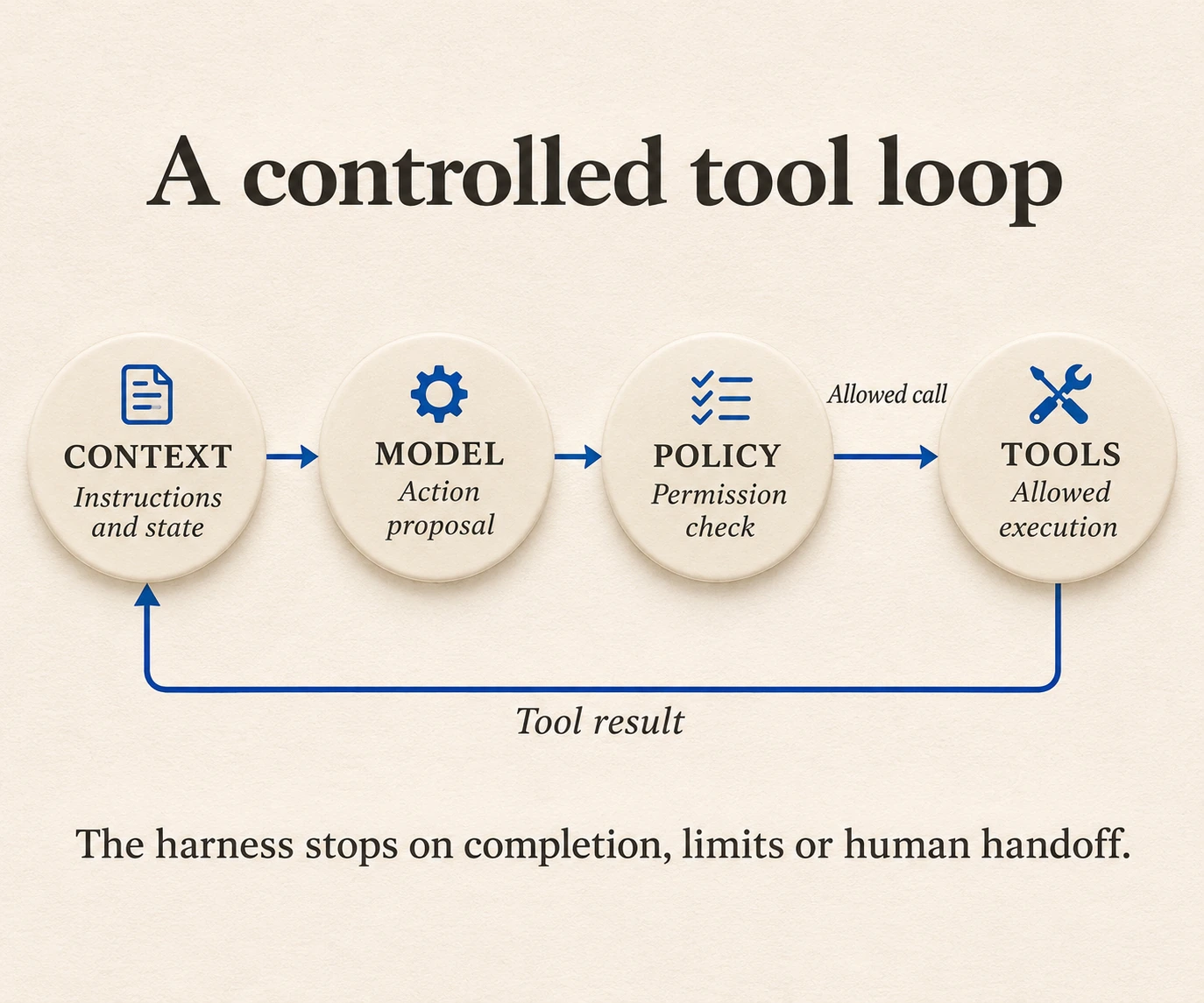
One distinction matters before any diagram. In a workflow, the path through the steps is written in code. In an agent, the model decides its own path and tool usage at runtime. The more dynamic the routing, the more you need a robust harness underneath, because every degree of freedom given to the model is one more thing to monitor.
A harness is the runtime layer around the model: it assembles context, calls the model, executes tool calls, manages the session and decides when the loop ends. Coding agents and general-purpose agents use harnesses of this kind, and both the harness and the model shape behavior.
The components of an agent system
Different vendors slice the stack differently, but the same parts recur. Google Cloud's component guide lists an agent development framework, frontend framework, security and governance, tools, memory, design patterns, agent runtime, AI models and model runtime. The practical version for a product team is shorter:
| Component | Responsibility | Typical design question |
|---|---|---|
| Model | Reasoning and language generation | Which model per task, and at what cost? |
| Instructions | Behavioral guidance and output format | Where are prompts versioned and tested? |
| Tools | External functions and APIs the agent can call | What may each tool read or change? |
| Memory and state | Working context, long-term knowledge, loop position | What persists across turns and sessions? |
| Orchestration and harness | Runs the loop, routes calls, coordinates agents | Hardcoded workflow or model-directed? |
| Runtime and sandbox | Isolated execution of code, files and commands | How is untrusted action contained? |
| Policy and observability | Permission checks, traces, evaluation | How do you see and stop a bad run? |
The model, tools and instructions form the minimal core in OpenAI's published guide to building agents: the model for reasoning, tools for action and instructions for behavior. One practitioner text, Agentic Systems, adds memory and state, and notes that these blocks meet in a single artifact: the context the model receives on each turn. That observation is useful for design, because context assembly can introduce missing, stale or irrelevant information that harms quality.
Memory deserves its own design
Memory splits into working state inside a session and durable knowledge across sessions. Retrieval, context windows and what to store or discard are separate decisions, and the questions interviewers and architects ask about them overlap heavily. If you want to stress-test your own understanding, this set of agent memory, context management and RAG questions walks through the same building blocks.
Policy sits between the model and the world
A clean design does not let the model touch business systems directly. SeeItFlow's component breakdown describes an orchestrator that resolves the proposed tool in a registry, asks a policy engine whether the call may go ahead and hands approved calls to an executor, which is the only component that holds credentials. Keep credentials out of model context and enforce authorization in the runtime, with access scoped to the relevant task and tenant. The exact executor and credential layout depends on your stack.
Architecture patterns and when each fits
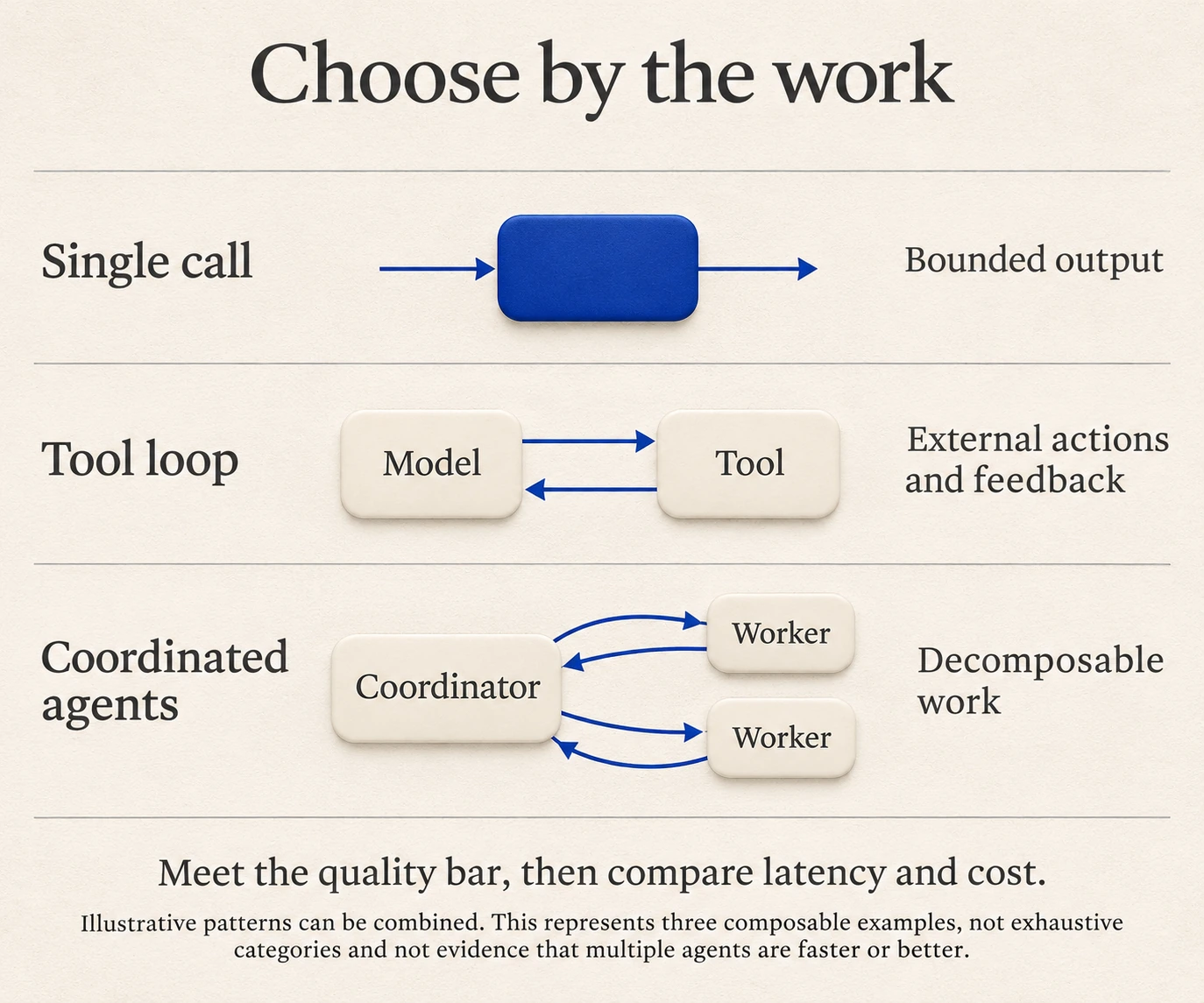
Patterns differ in who controls the path, how tools are used and how work is divided. The following seven examples describe call structure rather than fixed call counts:
| Pattern | Best fit | Call structure |
|---|---|---|
| Single-shot | Simple, bounded tasks | One model call; a baseline that may not need an agent loop |
| Tool use | Tasks needing external information | Model calls plus tool execution and any required follow-up |
| ReAct | Multi-step reasoning | Repeated decisions, actions and observations until a stop condition |
| Plan-and-execute | Complex sequences | Planning followed by execution steps |
| Reflection | Quality-critical output | Drafting followed by evaluation or revision cycles |
| Routing | Diverse query types | Rules may add no model call; a model classifier adds a call |
| Multi-agent | True role specialization | Agent calls plus coordination, bounded by the run budget |
These patterns can be combined and do not form a capability ranking. Measure quality, total model and tool costs, and end-to-end latency on your own workload.
ReAct is a multi-turn pattern. Google Cloud describes it as interleaving reasoning and task-specific actions, cycling through reason, act and observe. This does not require exposing a model's hidden chain of thought.
A useful way to choose is to start from the workload, not the pattern. The Agentic Systems Patterns book maps a known fixed sequence to prompt chaining, independent subtasks to parallel agents, unknown subtasks to an orchestrator with workers, and high-risk side effects to human approval gates. Its hierarchy runs from a single LLM call at level 1 to an autonomous long-running agent at level 8, and the guidance is to climb only as far as the task forces you to.
One agent or several
Adding agents feels like adding capability. The evidence says it depends on the shape of the task. Google Research evaluated 180 agent configurations across multiple architectures and benchmarks. In that study, centralized coordination improved performance by 80.9% relative to the single-agent baseline on Finance-Agent, while all tested multi-agent variants degraded performance by 39 to 70% on the sequential PlanCraft benchmark. The study reported error amplification of 17.2 times for independent agents versus 4.4 times for centralized systems. These are results from the tested configurations, not predictions for every workload.
Three practical rules follow:
- Parallel, decomposable work (research across many sources, independent checks) suits an orchestrator that dispatches workers and merges results.
- Sequential, state-dependent work (a plan where each step changes the next) usually suits one agent with good context.
- Independent agents without a coordinator had higher error amplification in that study, so test coordination and validation rather than assuming independent outputs are reliable.
If you cannot decide, Tech10 recommends starting hierarchical. Treat that as an option to test, not a measured claim about all production systems. Whatever you choose, run both a single-agent baseline and the multi-agent variant on the same tasks. Require acceptable quality and task success first, then compare latency and cost.
Designing the API and routing layer
The agent API is where architecture meets the product. Product code should send a task and receive a result or a stream of events, without knowing which model, provider or harness did the work. The reference design in AWS's seven-layer framework states that each layer has a distinct responsibility and a stable contract, and that model and inference choices should be driven by configuration, not hardwired into agent or application logic. It also describes a model routing layer that relies on a consistent request-and-response contract so models can be changed after evaluation without rewriting application logic.
A workable agent API has these properties:
- A stable task contract. Keep inputs, files, session identifiers and output events stable where supported, while handling model-specific capabilities and state compatibility.
- An explicit routing policy. Selection by quality, latency or cost happens in a layer you can tune, whether it is an application controller or part of the harness. Our notes on what an LLM router does cover the mechanics.
- Separate workflow logic and tool adapters. A practical guide published as an arXiv preprint argues for keeping backend workflow logic, a lightweight MCP server and user-facing clients distinct, which improves maintainability and independent scaling.
- Session lifecycle management. Creating, resuming, storing and ending sessions is part of the API surface, not an afterthought.
Protocols define the seams between these layers. Which standard governs which seam is covered in AI agent protocols in 2026 and in the comparison of UHP and MCP. For a product-feature view of the same idea, see the AI agent API guide.
Tuning for quality, latency, cost and security
The four goals pull against each other, and architecture is where you set the trade.
Match the model to the task
OpenAI's guide advises building the prototype with the most capable model for every task to set a baseline, then swapping in smaller models to see whether results stay acceptable. That order avoids limiting the agent too early. Simple retrieval or intent classification often runs on a smaller, faster model, while a consequential decision may justify a stronger one. For a method, read our piece on AI model selection, and for structuring the comparison, an evaluation guide for agent development is a helpful companion on baselines.
Benchmark on your own tasks rather than on public leaderboards. The approach is laid out in AI model benchmarking on your own workload.
Pay for control where it matters
Security controls can affect latency and cost, so evaluate them alongside task success and attack resistance. OpenAI's guide recommends layered guardrails, least-privilege tool access and human intervention for high-risk actions. Enforce permissions outside the model and validate proposed actions before execution. The design lesson: put restrictive controls where side effects are costly, and measure the overhead on your own workload.
Latency and cost compound with calls
Because pattern choice multiplies calls, one optimization to test is using fewer loop iterations on the simplest pattern that passes your evaluation. Another is routing simple requests to smaller models and reserving stronger models for hard steps, while checking task success and retry costs.
Testing, monitoring and deploying
Production adds requirements that diagrams omit. The practical guide on designing and deploying agentic workflows lists nine practices, including single-responsibility agents, externalized prompt management, separation of workflow logic from MCP servers, containerized deployment and the KISS principle, and recommends containers with Kubernetes orchestration in its self-managed deployment approach. That is one approach, not a requirement for every agent architecture; managed runtimes can provide the execution environment and lifecycle. TenX's reference architecture adds accountable identities with least-privilege authority, human oversight at runtime and evaluation-gated improvement.
A compact production checklist:
- Isolate execution. Run untrusted code, file operations and shell access in a sandbox separated from the application process.
- Give each agent least privilege. Scope tools and credentials per task.
- Trace every run. Record model and tool calls, relevant inputs and outputs, latency and cost with sensitive data redacted or access-controlled. Traces support investigation; deterministic replay also requires compatible state and execution conditions.
- Gate changes with evaluations. A prompt, model or harness change ships only if it holds on your benchmark set.
- Keep a human gate for high-risk side effects. Refunds, deletions and external messages are the usual candidates.
- Plan session storage. Decide what is retained, for how long and where.
The layers above infrastructure are mapped in the seven-layer agent stack, and the cost and control questions are treated in AI agents in production. For everything the application needs around the agent, see the backend for AI agents.
Running this architecture on HarnessRouter
HarnessRouter is the world's first unified interface for agent harnesses. It combines one Agent API, serverless execution in isolated sandboxes, and tracing to understand runs and optimize the Harness × Model configuration for each task. It lets teams integrate, benchmark and manage supported agent harnesses in production applications, with backend capabilities for sessions, files, plugins, environments and execution lifecycle. Its unified Task, Run and Session contract covers output streams, files and artifacts, beyond model request forwarding. HarnessRouter supports 30+ harnesses and growing, including Codex, Claude Code, Hermes and Pi, and is built on the open Unified Harness Protocol (UHP).
Harnesses, models, providers, skills, tools, plugins, memory and sandboxes are modular building blocks. Teams configure supported combinations and benchmark them for quality, latency and cost; compatibility, permissions and state migration still need to be checked. The cloud platform provides managed agent execution in isolated sandboxes, and the open-source Community Edition supports self-hosting.
The plans are published on the pricing page: Free at $0 per month, Developer at $20 per month, Production at $200 per month and Scale at $1,000 per month, with Enterprise priced on request. Tracing is included in Scale during beta and is a $50-per-month add-on on the other listed plans. BYOK routing is free for monthly model usage of up to $25,000 at listed prices; usage above that volume has a separate 5% routing fee. Top-up credit processing carries a 5.5% fee with a $0.80 minimum. Check the current pricing page for terms. Teams that prefer to self-host can start from the Community Edition.
If your next step is wiring an agent into a product, begin with the AI agent API guide and the HarnessRouter site.
Our perspective: the harness is a commodity layer
We see agent architecture as a stack in which every layer should be replaceable. Models improve and reprice quickly, providers change, and new harnesses appear regularly. A design that hardwires one of them into application logic can make those changes require application rewrites.
That is why we built HarnessRouter as a unified interface for agent harnesses, in the way a model router unifies model providers. With supported harnesses, models, providers, skills, tools, plugins, memory and sandboxes available as modular building blocks behind one API, the architecture question includes evaluation: which compatible combination meets the quality bar on this task, and at what latency and cost?
We also believe the interface between those layers should be open. The Unified Harness Protocol exists so the harness layer can be an open infrastructure layer, and teams can build across supported harnesses, models and sandbox providers with less dependence on proprietary application interfaces. Our open-source Community Edition follows the same principle.
HarnessRouter Editorial Team
FAQ
What are the core components of an AI agent?
At minimum, a model for reasoning, tools for taking action and instructions that define behavior. Production systems add memory and state, a harness or orchestrator that runs the loop, an isolated runtime, and policy and tracing layers.
Which AI agent architecture pattern should I start with?
Start with the simplest pattern that passes your evaluation, usually a single call or tool use, and move to ReAct or plan-and-execute only when the task needs multi-step reasoning. Add multi-agent coordination only when measured benefits justify it, whether for parallel work or role-specific decomposition.
Is a multi-agent system always better than a single agent?
No. In the configurations it tested, Google Research found gains on the parallelizable Finance-Agent benchmark with centralized coordination, and degraded performance across tested multi-agent variants on the sequential PlanCraft benchmark. Test both on your own workload.
How do I keep an agent architecture from locking me into one model or provider?
Put a stable request-and-response contract between application code and the model layer, and drive model choice through configuration. A routing layer and a harness-level interface extend the same idea to providers and harnesses.
What does an agent API architecture need beyond model calls?
Session management, file handling, tool and plugin integration, environment provisioning, and tracing. These support resumability and auditing when the selected harness and stored state allow it. Safe product integration also requires enforced permissions, isolation, evaluation and appropriate human gates.
Sources
- AI Agent Architecture: Components & Types
- AWS Prescriptive Guidance: Foundations of agentic AI on AWS
- Choose your agentic AI architecture components
- A practical guide to building agents
- Chapter 2: The building blocks
- AI Agent Components Explained
- Core concepts of AI agents
- Choosing the Right Pattern, Agentic Systems Patterns
- Towards a science of scaling agent systems
- Hierarchical, Swarm, Sequential: Multi-Agent Patterns
- Pluggable Agentic AI Framework: seven-layer reference architecture
- A Practical Guide for Designing, Developing, and Deploying agentic AI
- Agentic AI Reference Architecture
- Agent memory, context management and RAG questions
- AI agent development evaluation guide