
Serverless AI agents are agents whose compute is provisioned per request or per event rather than kept running on a server you manage: capacity scales with arriving work and drops to zero when idle. The function model works well for short, stateless, idempotent tasks and needs durable orchestration for long, stateful runs, where the agent needs a runtime that handles session state, isolation and lifecycle for you. HarnessRouter provides a serverless agent runtime lifecycle, so you can deploy agents without servers and still keep sessions, files and plugins across a long task.
TL;DR
- In an API-based architecture, a serverless agent combines event-triggered compute, an external model provider, tools and an external state store. Warm functions may retain local state, but durable recovery cannot rely on it.
- Function platforms impose hard execution limits (AWS Lambda limits depend on execution mode and deployment), and a multi-step agent can approach them quickly.
- Statelessness and retries are the two main failure modes: lost working memory and duplicated side effects from non-idempotent tool calls.
- Scale to zero is the cost advantage for bursty workloads. Cost control depends on tracing what each task consumes.
- For long-running or stateful agents, a managed agent runtime with session management and sandboxes removes the plumbing. See the HarnessRouter pricing for plans starting at $0 per month.
What serverless AI agents are
A traditional agent deployment runs a long-lived process: a container or virtual machine that holds the agent loop, its conversation history and its open connections. You pay for it while it idles, and you patch, size and restart it.
A serverless agent inverts that. The loop is split into invocations that a platform starts when something happens: an HTTP request, a queue message, a schedule. The platform allocates compute for the duration of the call and releases it afterward. The platform is designed, in the words of its documentation, for time-limited compute tasks. Warm execution environments may be reused, but local state is not a durable recovery contract.
In this API-based design, the function calls an external model provider and waits. Anything the agent must reliably remember across invocations has to live in durable storage outside the function.
The phrase "serverless" also covers a second pattern: a managed agent runtime that provisions an isolated environment per task and tears it down afterward. The distinction matters, because a general function platform gives you a time-limited function, while an agent runtime gives you an environment built for the shape of agent work. Both scale with demand and neither requires you to operate a server.
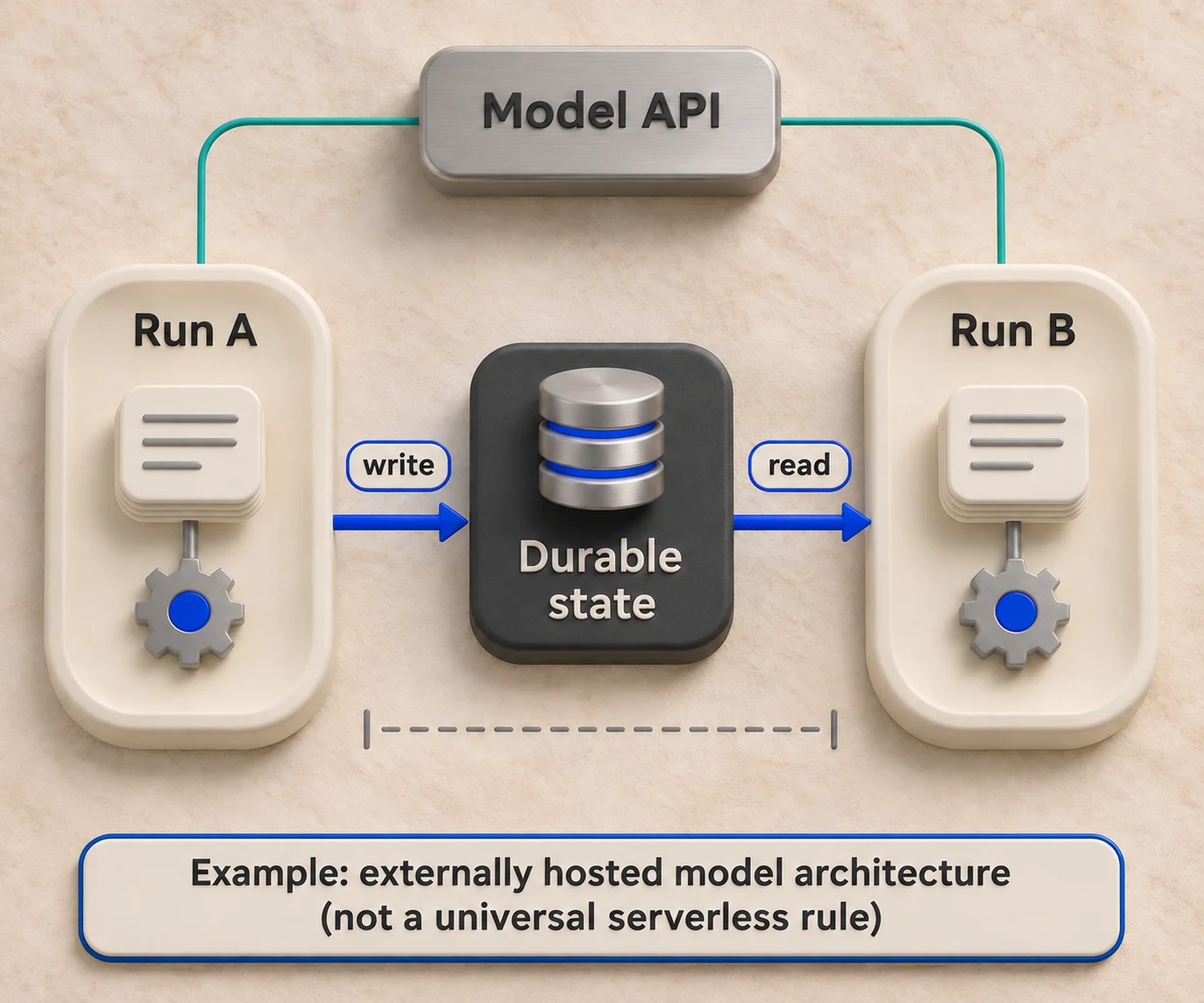
The components of a serverless agent system
A published architecture guide lists the parts that a function-based agent needs. In practice you assemble six pieces:
| Component | Role | Typical failure when missing |
|---|---|---|
| Event trigger | HTTP request, queue message or schedule that starts a run | Runs cannot be retried or rate-limited cleanly |
| Compute | The function that executes one step or one run | Timeouts on long tasks |
| Model provider | External LLM API called from the function | Single-provider outage or lock-in |
| Tools | Functions, MCP servers, file and code execution | Agent cannot act, only answer |
| State store | Conversation history, memory, intermediate results | Context lost between invocations |
| Orchestrator | Routing and sequencing across steps or agents | Steps run out of order or twice |
The same guide describes a three-tier state model: short-term memory inside the function, medium-term key-value storage, and long-term object storage. The practical rule is to write anything you will need after the function returns to the second or third tier before it returns.
For a deeper view of how these layers fit together, see our notes on AI agent architecture and the seven-layer agent stack.
Limits and failure modes to plan for
Execution time
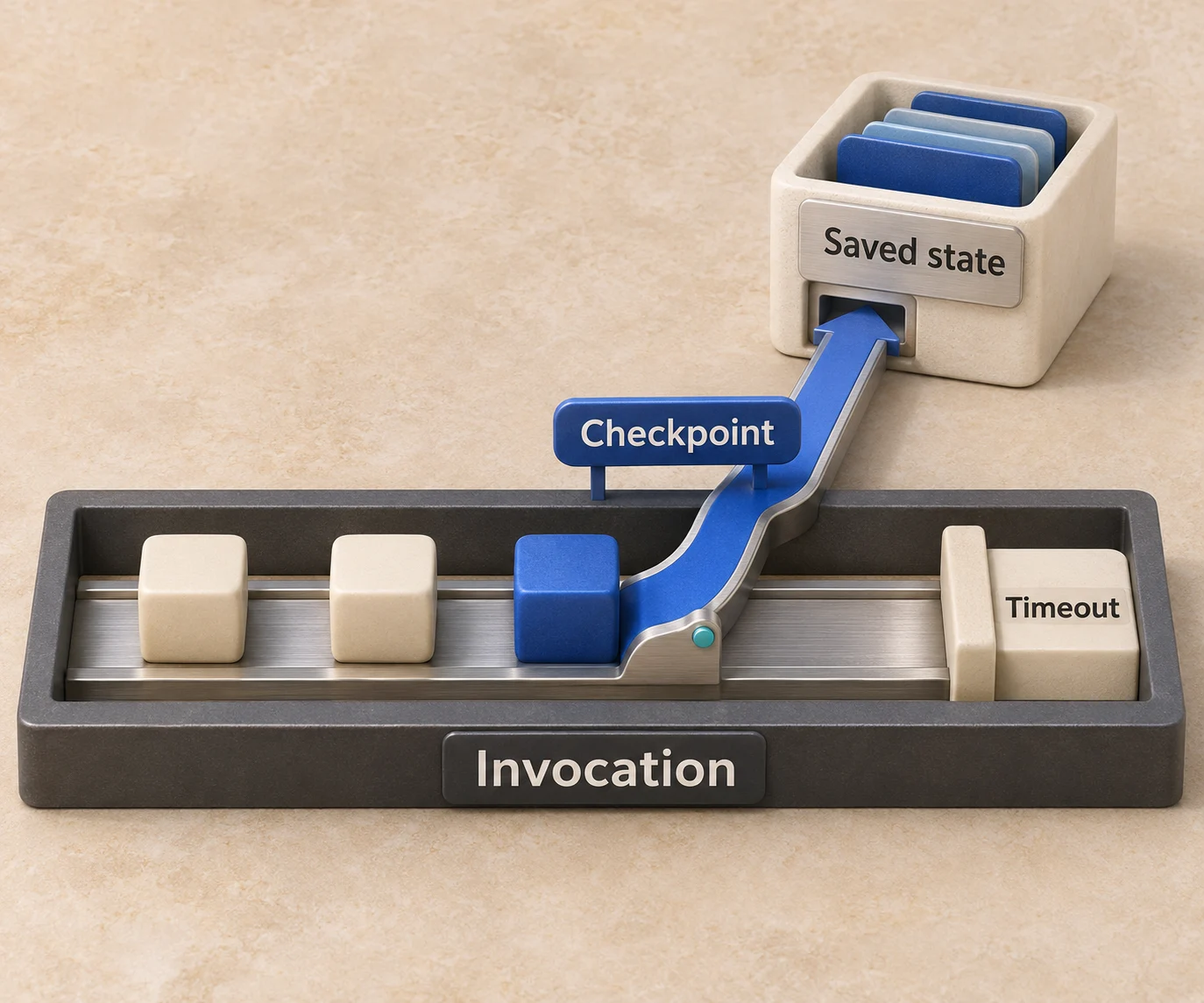
Every function platform caps how long one invocation can run. AWS documents mode- and deployment-specific invocation limits, with 6 MB limits for synchronous requests and buffered responses and a separate 200 MB streamed-response limit. Other platforms set different ceilings, and those figures change by plan, so confirm them on the provider's current limits page before you size a design.
Agents consume time faster than ordinary request handlers. Engineers at one infrastructure consultancy estimate that an agent making four sequential tool calls, a database write and two model calls can reach 3 to 8 minutes of elapsed time. Time spent waiting on model or tool APIs can still be billed as function duration.
Lost working memory
Because function-local state is not guaranteed to survive between invocations, an agent that splits a task across steps loses its scratch state at each boundary unless you persist it. Symptoms include an agent that repeats a search it already ran, forgets a file it created, or restarts a plan from step one after a retry.
Duplicated side effects
Queues and function platforms retry failed invocations. If the invocation sent an email, charged a card or opened a ticket before it failed, the retry can do it again. The same engineering write-up proposes a rule of thumb: start with serverless when P95 execution time is under 4 minutes and no tool call has non-idempotent side effects. An idempotent operation is one that produces the same result whether it runs once or several times, which requires the receiving service to enforce a stable idempotency key for the same logical action, or application-level deduplication and reconciliation.
Cold starts and concurrency
A cold start is the delay while the platform prepares a fresh execution environment. For agents calling a model that takes seconds to respond, a brief cold start is rarely the bottleneck, but concurrency is. AWS lists a scaling limit of 1,000 execution environments every 10 seconds per function, and model providers apply their own rate limits, so a burst of agent runs can hit the provider before it hits the platform.
When serverless is the right fit
Use the function model when the workload matches its shape:
- Short, deterministic tasks. Classification, extraction and summarization finish quickly and need little state.
- Bursty demand. A nightly batch that triggers one agent run per queue item should not pay for a worker that idles for the other twenty hours.
- Event-driven flows. A webhook, an upload or a schedule starts a run and nothing needs to stay connected afterward.
- Early stage products. Scale to zero means a prototype costs close to nothing until it has traffic.
It fits less well when a run needs to hold a workspace for many minutes or hours, edit files across steps, run code in a sandbox, or call tools that cannot safely run twice. Those are the agent workloads where the loop, the files and the environment must survive for the length of the task.
How to deploy agents without servers
The steps below apply whether you build on a function platform or a managed agent runtime. At each step, we note what HarnessRouter handles when you use it.
1. Define the unit of work
Decide what one run does and how long it should take. Measure P95 elapsed time on a realistic sample, not the average. Runs near a platform limit need splitting or a different runtime.
2. Choose the harness and model
The agent harness is the loop around the model: prompt assembly, tool calls, context handling. Locking one harness and one provider into your functions makes later changes expensive. HarnessRouter exposes harnesses such as Codex, Claude Code, Hermes, DeepSeek and Pi behind one API, with supported harness and model combinations, so changing the harness or model is a configuration change instead of a rewrite. For background, read what an agent harness is.
3. Externalize state from the start
Write history, files and intermediate results to durable storage before an invocation ends. On a function platform you build and secure that store yourself. HarnessRouter provides agent session management and file handling, and its Harness Memory offers long-term memory for agents. Our guide to agent state management covers the patterns in detail.
4. Isolate tool execution
Agents that run code or touch files need an isolated environment, to separate local files and processes between runs. Network access, credentials and external tool permissions need separate controls. HarnessRouter runs each task in an isolated sandbox and provisions the environment, plugins and tools for it, which replaces the per-run container wiring you would otherwise maintain.
5. Make side effects safe to retry
Use a stable idempotency key per logical outbound action when the receiving service enforces it. Otherwise use concurrency-safe deduplication and reconcile uncertain outcomes; a check-then-act record alone leaves races and a crash window after the action. This step is yours in any architecture, because only your application knows which actions are unsafe to repeat.
6. Wire triggers and a backend
Expose runs through an API, queue or schedule. If the product feature is user-facing, our AI agent API guide shows how a single endpoint can drive agent sessions, and the backend for AI agents post lists what a complete backend includes.
7. Trace every run
Record model calls, tool calls, latency and cost for each run. Without traces you cannot say which step hit a limit or consumed the budget. See AI agent observability for what to capture.
Scaling serverless agents reliably
Scaling is mostly a matter of queue discipline and provider limits rather than compute:
- Put a queue between the trigger and the agent. It absorbs bursts and lets you cap concurrency below the model provider's rate limit.
- Set explicit timeouts shorter than the platform limit. Leave time to save a checkpoint and stop cleanly. A timed-out run can also resume from its last durable checkpoint, but uncertain external actions need reconciliation.
- Checkpoint after each tool call. Persist the result so a retry resumes rather than restarts.
- Split long plans into durable steps. Durable workflows save progress and let a long-running agent release compute while it waits, then resume later.
- Watch the tail, not the mean. P95 and P99 duration predict timeouts. Average duration hides them.
An approach recommended in a 2026 engineering article is to begin serverless and move a workload only when production data shows it needs something else. That keeps the decision empirical.
Controlling the cost of serverless agents
Function billing is based on duration and memory, so the waiting time of an agent loop is billed even though your code is not working. Three levers control the total:
- Right-size memory. On AWS, CPU is allocated in proportion to configured memory, so over-provisioning raises cost without speeding up a function that is waiting on a model.
- Route each task to an appropriate model. Model tokens usually dominate the bill. Matching the model to the task is the largest saving, and it is where optimizing for quality, latency or cost per task pays off. HarnessRouter lets you benchmark and configure compatible harness, model and module choices per task for your objective, and the company states that this cuts agent costs by over 90%, a figure to validate on your own workload.
- Measure per run. Cost per completed task is the figure to track, not cost per invocation.
On HarnessRouter Cloud, the published plans are Free at $0 per month, Developer at $20 per month, Production at $200 per month and Scale at $1,000 per month, with Enterprise on request. Usage fees include agent short-term memory (Beta) at the list rate of $0.0000840 per GB-hour, with plan discounts; long-term memory is billed separately per operation. Tracing is in beta and included with Scale; see the pricing page for current add-on terms. Top-up credit processing carries a 5.5% fee with a $0.80 minimum. Routing with your own API keys carries a BYOK routing fee of 0% for up to $25,000 in monthly model usage at list prices, with a 5% routing fee above that volume; agent work and memory remain separately billable. Details are on the pricing page.
Perspective
We treat the agent harness as infrastructure, not as application code. Most serverless agent designs start by gluing a function, a model SDK and a database together, and each of those choices becomes a dependency that is expensive to undo.
Our position is that the harness, the model, the sandbox and the memory should be interchangeable parts behind one interface. That is why we initiated the open Unified Harness Protocol (UHP) and why HarnessRouter supports multiple harnesses today: you pick what fits the task, and you change it without rewriting your product.
Serverless is the right operating model for agents because demand is bursty and idle capacity is waste. But the function is the wrong place to keep an agent's session, files and environment. A runtime built around agent lifecycle, with isolated sandboxes per task, lets you keep the scale-to-zero economics while the task keeps its state within the applicable plan and session-retention limits.
The open-source Community Edition exists for teams that want to run the same interface themselves, and the cloud platform exists for teams that would rather not.
Running agents on HarnessRouter
If your agents outgrow the time limit of a function, or you want to change harnesses and models without redeployment, HarnessRouter assembles the harness, model and modules for each task and runs them in an isolated sandbox, with session management, file handling, plugin support and environment provisioning included. Start on the Free plan at $0 per month and move to Developer at $20 per month when you need more, or self-host the Community Edition.

See the plans and usage fees to match a plan to your traffic, or read our guide on deploying AI agents from prototype to production.
FAQ
What is the difference between serverless AI agents and traditional AI agents?
A traditional agent runs as a long-lived process that you size, patch and keep running. A serverless agent runs in event-triggered compute that is allocated per request and released afterward, so it scales with demand and to zero when idle. The trade-off is that state must live outside the compute.
How do I deploy agents without servers?
Trigger runs from an API, queue or schedule, call an external model provider, store state and files outside the compute, and isolate tool execution. You can assemble this from a function platform, or use a managed agent runtime such as HarnessRouter, which provisions the sandbox and session for each task.
How do I scale serverless agents?
Place a queue in front of the agents, cap concurrency under your model provider's rate limit, set timeouts below the platform limit and checkpoint after each tool call. Track P95 duration to see which runs approach a limit before they fail.
Can serverless agents handle long-running tasks?
Only within the limits of the selected execution mode and deployment inside a single function invocation. Long tasks need durable steps with saved progress or a runtime built to hold a session and its environment for the whole task.