

Quick answer
The four layers under an AI product
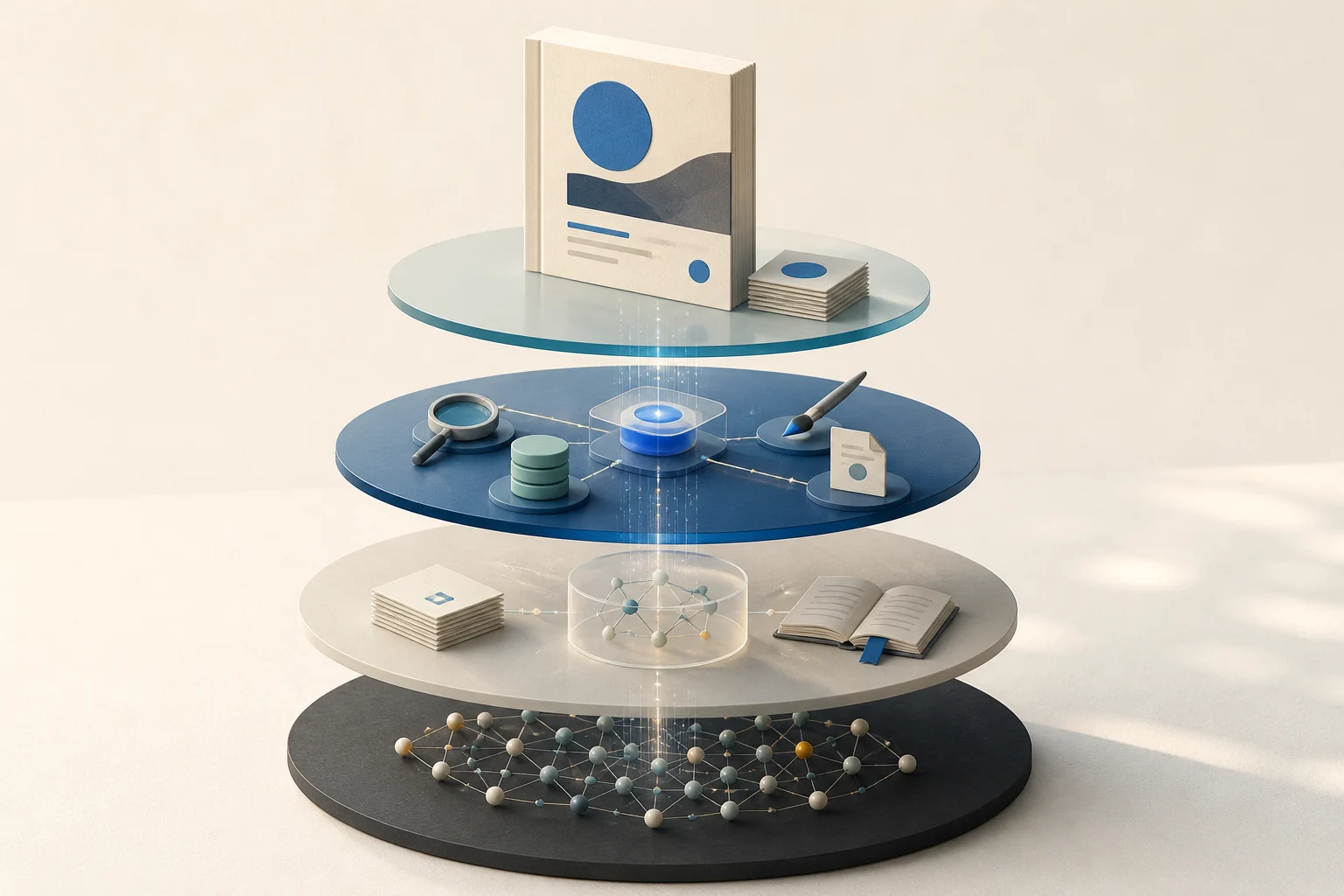
An AI product stands on four infrastructure layers: the model layer that reasons, the context layer that decides what the model sees, the harness layer that turns model calls into completed work, and the unified interface layer that connects complete harnesses to your product.
Teams building AI products in 2026 tend to share one observation: the model itself is less and less the bottleneck. Models keep improving on their own schedule. What separates a demo from a product that earns revenue is the infrastructure wrapped around the model, and that infrastructure has settled into a recognizable shape.
This guide walks up the four layers in order: what each one does, why it exists as a separate layer, and whether your team should build it or adopt it. The higher layers are where the interesting decisions live, because they are the ones most architecture discussions still draw wrong.
Layer 1
The model layer: an engine, not a product
The model layer is where everything starts: hosted APIs for the frontier models, and open-weight models where cost, privacy, or offline constraints demand them. It is also the layer where the least of your engineering time should go, because you cannot build it and should not try to own it.
What you can own is how you consume it. Structured output, so responses parse into your types instead of free text. Tool calling, so the model acts through functions you define, which is the boundary between chat and execution. And disciplined selection: models are re-ranked by the market on a schedule you do not control, so the choice has to rest on evals run against your own tasks, cheap enough to rerun every time the market moves.
The load-bearing idea at this layer: the model is an engine. Engines get swapped. Any architecture welded to a single model becomes a liability on someone else's release calendar.
Layer 2
The context layer: what the model actually sees
However capable the model, at each step it sees only what you hand it. The context layer manages that handoff, and it splits into two disciplines. Retrieval infrastructure, vector databases such as pgvector and Epsilla plus the chunking and embedding pipeline around them, determines what the system can know. Context engineering, deciding what to store, retrieve, and present at each step, determines what the model actually sees.
In single-shot use this layer is barely visible. In agent work, where a task runs across many steps, context management decides whether the agent stays locked on the task or loses it halfway through. It is one of the genuinely hard problems in agent systems. The mechanics of managing context during a task ship inside the next layer up; what stays yours at this layer is the knowledge itself: the corpus, the retrieval quality, and what your product should know.
Layer 3
The harness layer: the one most architectures misfile
This is the layer this guide exists to put in its right place. An agent harness is the runtime layer built around the model. It is what lets a model call tools and skills, hold a session, work with files, stream progress, recover from failure, and deliver a finished result. Concretely, a complete harness does six jobs:
- Runs the execution loop: plan, act, check the result, repeat.
- Manages working context during a run: the mechanics of the layer-two problem, handled inside the harness.
- Exposes tools and skills the model can call.
- Enforces permissions: what the agent may touch, and nothing else.
- Sandboxes execution, so the blast radius of a wrong command is a sandbox, not your infrastructure.
- Recovers from failure mid-task and decides when the task is actually done.
Note the fifth job: sandboxing lives inside the harness contract. It is not a separate operational burden sitting on the user's shoulders, and layer diagrams that draw it as one are drawing it wrong.
Claude Code, Codex, and Hermes are complete harnesses in exactly this sense, each with continuous vendor engineering behind it. Tool roundups file them under coding assistants, which undersells what they are: the same engine that refactors a codebase can process documents, generate reports, and power the agent features inside a product.
Can you build this layer yourself? Yes, and the accounting matters. A demo loop takes days and is the smallest part of the work. Context management, the tool surface, sandboxing, and edge cases dominate the build, followed by the production infrastructure tutorials skip, followed by a maintenance tax that never ends, because the harnesses and models underneath evolve continuously.
Layer 4
The unified interface layer: many harnesses, one contract
Suppose you agree with the harness-layer conclusion: use complete harnesses rather than rebuilding one. The next problem appears immediately. Putting a harness behind a product is a different job from using one in a terminal. A product integration has to cover the full execution lifecycle: harness selection and configuration, task execution, progress updates, session and file management, cancellation, error handling, and results. And every harness exposes that lifecycle differently, so each one is its own integration, and your backend couples to whichever one you picked first while the market keeps shipping alternatives.
That is the problem the fourth layer solves. HarnessRouter is the world's first unified interface for agent harnesses: through one API, your product runs complete agent tasks on Codex, Claude Code, or Hermes, with task execution, sessions, files, streaming progress, and results behaving the same way across every harness. An isolated sandbox spins up for each task and the pool grows with your workload automatically, so parallel runs never mean standing up execution infrastructure of your own. This is what deploying agents to the cloud means in practice: serverless agent infrastructure scheduled per task, not capacity you pick, pre-provision, or operate, and distinct from the separate pattern of agents provisioning and operating application infrastructure of their own.
The deeper payoff is that configuration becomes a measurable variable. Execution tracing records every run, so teams can test combinations of harness, model, skills, and tools, compare results, and route each kind of task to the configuration that performs best. In HarnessRouter's same-task benchmark, eight harness and model configurations ran identical work five times each: cost varied by about 475x, and the lowest-cost successful run used 99.8% fewer credits than the costliest configuration. Results vary by task, which is exactly the point: cost and success are properties of the combination, not of the model alone, and a stack that cannot switch combinations has no way to capture whatever spread exists on its own workload.
The decision
Build or adopt, layer by layer
The four layers come with four different answers to the build-or-adopt question:
- Model layer: adopt. Own the consumption discipline (structured output, tool calling, evals); training your own frontier model is a different business.
- Context layer: adopt the components, own the engineering. Retrieval quality is a legitimate place to differentiate when your data is the moat.
- Harness layer: build it when the execution engine itself is the product you sell. If you sell product features rather than an engine, adopt a complete harness.
- Unified interface layer: skip it only when one harness, no comparison, and no switching is genuinely the plan. Keeping the option to measure and move is the point of the layer.
One sentence to carry out of this guide: treat the model as the engine, the context layer as the fuel line, the harness as the complete drivetrain, and the unified interface as your contract with the whole drivetrain market. Each layer turns the complexity below it into a capability you call, and your engineering time belongs to the part of your product that sits above all four.
FAQ
AI product infrastructure FAQs
What are the infrastructure layers of an AI product?
Four: the model layer (reasoning via hosted or open-weight models), the context layer (retrieval and context engineering that decide what the model sees), the harness layer (the runtime that turns model calls into completed tasks, including tools, permissions, sandboxing, and recovery), and the unified interface layer that connects complete harnesses to products through one contract.
What is the harness layer?
The harness layer is the runtime built around a model: the execution loop, context management, tools and skills, permissions, sandboxing, and failure recovery that carry a task from request to finished result. Claude Code, Codex, and Hermes are complete harnesses. It sits above the model and context layers and below the unified interface that products integrate against.
Is sandboxing a separate infrastructure layer?
No. Sandboxed execution is a job the harness layer performs, and when harnesses run through HarnessRouter, every task executes in an isolated sandbox the platform provisions on demand. It becomes your operational concern only if you assemble your own agent system from parts.
Should my team build its own harness layer?
Only if the execution engine itself is the product you sell. The loop is the smallest part of the work; context management, sandboxing, production infrastructure, and a permanent maintenance tax dominate the cost. Teams shipping product features are usually better served adopting complete harnesses and keeping the ability to compare configurations.
Build your product on the harness layer
Run Codex, Claude Code, and Hermes behind one API, with isolated sandboxes and execution tracing included.
Start building free