
Generative AI SaaS is cloud software, sold through subscriptions, usage-based billing or a combination, in which a model creates the primary output the customer pays for. For a team building one, the hard part is rarely the first model call. It is the layer around it: harnesses, models, providers, tools, memory and sandboxes that have to be swapped, benchmarked and paid for without rewriting the product. We built HarnessRouter to be that layer, so the product team keeps its attention on the customer-facing workflow.
TL;DR
- Generative AI SaaS delivers model-created output (text, code, documents, images, actions) through a complete software product, which separates it from a bare model API and from a classic SaaS app with an AI feature added.
- Model inference adds a usage-dependent marginal cost to ordinary SaaS operating costs, so pricing, margins and routing decisions belong in the architecture from the first sprint.
- Teams that integrate several models and agent harnesses through one interface can compare configurations for each task against quality, latency and cost requirements, and reduce vendor dependence.
- HarnessRouter exposes harnesses, models, providers, skills, tools, plugins, memory and sandboxes as configurable building blocks behind one API where supported by the selected harness, starting with a $0 monthly plan and metered usage.
What generative AI SaaS actually is
These three related concepts overlap, but distinguishing them helps avoid wrong architecture decisions.
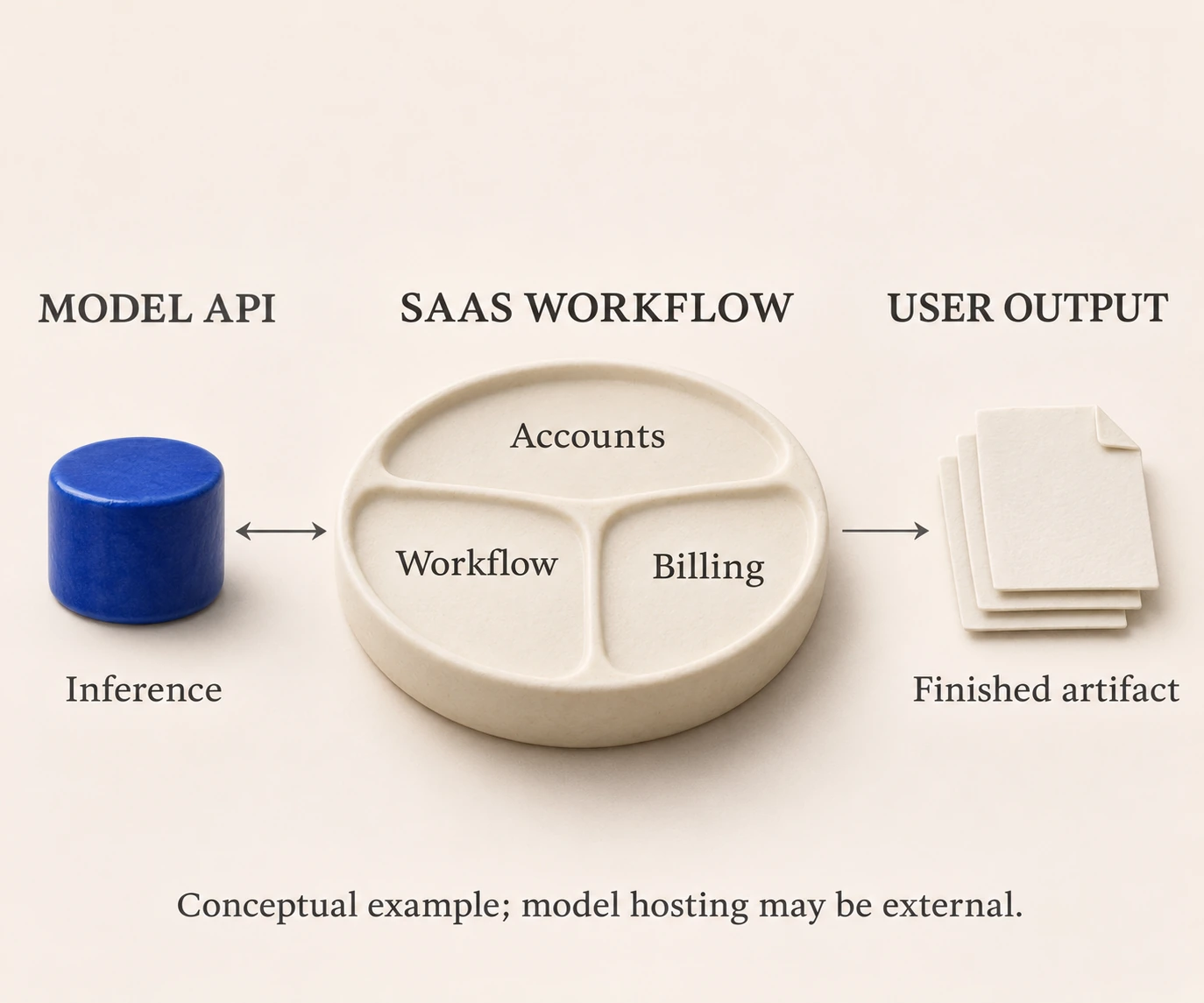
A model API. SymphonyAI describes general-purpose model APIs as components that developers integrate into their own applications, whereas AI SaaS is a complete, workflow-ready application for a specific business use case, with the application vendor maintaining the product and arranging model access, whether self-hosted or provided by another vendor. A model API is a programmatic interface and can include authentication, billing and support; it does not by itself supply the finished application workflow.
A SaaS product with an AI feature. Forbes draws the line this way: AI features inside a CRM serve only that CRM, whereas a model API is intelligence offered as a service to be embedded elsewhere. A mature product that adds, for example, lead scoring on top of an unchanged stack is what Featherflow calls AI-enhanced SaaS.
An AI-native product. TechEniac states that the defining trait of generative AI SaaS is that the AI creates the primary output users pay for, rather than merely supporting the interface. In an agentic AI-native pattern, the user sets an outcome and the system plans and executes the steps. Other generative AI products produce a draft for human review; autonomy and usage- or outcome-based pricing are choices, not requirements.
The same TechEniac article describes the weak end of this spectrum, the "wrapper": a text field wired to a model API, a thin interface and a monthly fee. That comparison is a useful product-design question, but it does not establish a universal retention rate or prove that engineering alone determines whether customers stay.
What generative AI SaaS produces in practice
Products in this category generate on demand. G2's overview groups SaaS use cases into seven families: content generation, personalization, design automation, language translation, data insights, voice and video intelligence, and in-product assistants. The output types behind them are text, documents, code, images, summaries, translations and structured data.
For a team planning a roadmap, the more useful distinction is how much autonomy the product has. Drafting content that a person accepts is one end. At the other end, the product acts on the user's behalf: it opens files, calls tools, runs code and returns a finished artifact. That second pattern is where agent harnesses enter, and where infrastructure complexity grows fastest. Content-focused products, such as those built around automated content generation, show the first pattern at scale. Action-taking products need a runtime that can execute safely.
How generative AI SaaS differs from traditional SaaS
Netguru puts generative AI SaaS at the inference layer: user requests pass through a model that produces probabilistic output, not the deterministic logic of rule-based software. SpiderHunts adds the commercial consequence: many traditional SaaS products spread infrastructure costs across users, while AI SaaS adds inference costs that can grow with model use. Per-seat, tiered and usage-based pricing can occur in both.
| Dimension | Traditional SaaS | Generative AI SaaS |
|---|---|---|
| Core logic | Fixed rules written by developers | Models that produce probabilistic output |
| Cost per use | Compute, storage and other marginal costs | Same, plus inference when models run |
| Typical pricing | Seats, tiers or usage | Seats, tiers, usage or credits |
| Operations | Servers, storage, support | Same, plus inference, evaluation, AI-specific monitoring |
| Main architectural risk | Scaling infrastructure | Model dependence, cost drift, unbounded agent behavior |
APIDots notes that operating an AI-native product adds model inference and AI-related operations to the usual infrastructure, storage and support, and that governance needs access controls, audit logs and business rules together with AI-specific safeguards and monitoring.
The stack beneath the product
A generative AI SaaS product that acts, instead of only answering, has several layers that each need a decision:
- Model and provider. Which model serves which task, and through which provider.
- Agent harness. The loop that gives a model tools, context management and control flow. Coding agents are the familiar example.
- Skills, tools and plugins. What the agent can call.
- Memory and session storage. What persists across turns and tasks.
- Sandbox. Where generated code and tool calls run, with isolation, network access and credentials configured for the workload.
- Tracing and benchmarking. How you see what happened and compare configurations.
We lay out these layers in more detail in our guide to the AI agent stack and in The Backend for AI Agents. The point for a product team is that each layer has several competing implementations, and the right one changes per task and per quarter. A hard-coded choice at any layer becomes a migration later. Our post on model layer to harness layer infrastructure covers why the harness is becoming the layer where this choice matters most.
Integrating multiple models and harnesses
Why more than one? Quality, latency and cost rarely peak in the same model. A short classification call, a long-context analysis and a multi-step coding task each have a different best fit. Teams that route per task treat the choice as configuration, not code.
The integration work breaks down like this:
- Normalize the interface. Every harness and provider has its own session semantics, file handling, authentication and streaming format. Without a unified contract, each one is a custom adapter.
- Define the routing objective. Set quality and reliability thresholds, then compare latency and cost per completed task type, and record the metrics you will judge it by.
- Isolate execution. Run generated code and tool calls in a sandbox with provisioned environments, and restrict network access and credentials so a faulty run has only the intended reach.
- Persist state deliberately. Decide what lives in session storage, what goes to memory and what is discarded.
- Benchmark before switching. Run the same task set against candidate configurations and compare outputs, cost and time.
- Keep keys under control. Decide whether model spend runs through the platform or through your own provider keys.
HarnessRouter is the world’s first unified interface for agent harnesses: one Agent API to run every supported harness in serverless, isolated sandboxes, with tracing to understand each run and optimize the Harness × Model configuration for each task. The shared backend contract covers task execution, sessions, streaming, tools, files and finished artifacts. Optimization here means observing, comparing and choosing supported configurations, not an automatic search for an optimal configuration. It supports 30+ harnesses, including Codex, Claude Code, Hermes, DeepSeek Harness and Pi, and covers agent session management, file handling, plugin support, environment provisioning, benchmarking tools and serverless agent runtime lifecycle features. It is built on the open Unified Harness Protocol (UHP), which we initiated so the harness layer becomes open, commoditized infrastructure, not a lock-in point. If you wonder how UHP relates to tool protocols, our comparison of UHP and MCP explains the different layers they occupy.
Integration failures can appear before the first useful result, depending on the model and stack. We catalogued them in System One Model Integration: What Breaks on the First Try.
What drives the cost, and how to control it
Cost is the property that most clearly separates this category from older SaaS. Per-request inference spend scales with usage, so a successful month can hurt margin. The reliable lesson is structural: you pay for compute each time a user triggers a generation.
Snowflake defines AI cost optimization as measuring and reducing the cost of building and running AI applications while holding quality, latency and reliability at the required level. Prompt-heavy requests may carry system instructions, retrieved documents, conversation history and tool results before returning a short answer. Token counts alone do not determine the bill: input, output and cached tokens may have different rates. Measure the actual token mix and provider prices before deciding which part dominates.
Three levers follow from that:
- Route by task. Compare supported model and harness configurations for each task, keeping the required output quality and reliability. This is the lever per-task routing exists for.
- Trim context. When input costs dominate, retrieval discipline and history management can reduce spend. Output length and caching can also matter; preserve the context needed to complete the task correctly.
- Measure per configuration. Without a benchmark for each harness and model pairing, any claimed saving is a guess.
HarnessRouter lets teams configure supported harnesses, models and modules, then compare their quality, latency and cost on representative tasks. Savings depend on the workload, configuration and baseline; there is no general percentage guarantee. That is why the benchmarking tools sit in the same interface as the routing.
Governance and production readiness
Before shipping, a team building generative AI SaaS should be able to answer these:
- Isolation. Where does generated code run, and what can it reach? Agent execution belongs in an isolated sandbox.
- Access control. Who and what can call which tools and data? Periodic access reviews, such as those described in this guide to SaaS access reviews, carry over to the service accounts and API keys that agents use.
- Observability. Can you trace a failed run end to end? HarnessRouter includes tracing with Scale during beta and lists a $50 monthly add-on for other plans; consult the current pricing terms.
- Vendor dependence. Can you change model, harness or sandbox provider without rewriting the product? An open protocol keeps that option.
- Data ownership. Bain & Company argues that SaaS providers should own their data, lead on standards and price for outcomes instead of log-ons. They also identify winners as the organizations that scale agent orchestration best.
Deployment choice matters here too. HarnessRouter ships as an open-source Community Edition for self-hosting and as a managed cloud, so a team can pick its own control and operations trade-off.
Pricing the build: what HarnessRouter costs
The plans, as published on our pricing page:
| Plan | Price |
|---|---|
| Free | $0 per month |
| Developer | $20 per month |
| Production | $200 per month |
| Scale | $1,000 per month |
| Enterprise | No published price |
Usage-based items sit alongside the plans. Agent short-term memory (Beta) is $0.0000840 per GB-hour on Free, with lower rates on paid plans; long-term memory is $0.0019 per memory operation with storage included. Tracing is included with Scale during beta and listed as a $50 monthly add-on on other plans. Top-up credit carries a 5.5% processing fee, minimum $0.80. BYOK routing has no fee up to $25,000 per month of model usage at listed prices; above that volume a separate 5% routing fee applies. Agent work has published per-active-minute rates: $0.020 without a paid plan, $0.014 on Developer, $0.010 on Production and $0.006 on Scale. Model, user and platform wait time is free. Check the current pricing page before budgeting; beta rates and terms can change.
Perspective: the harness layer is the new integration point
A generative AI SaaS product can start as one model behind one interface and later discover that the interface was the easy part. The model changes, a new harness outperforms the old one on a task class, a provider has an outage, and the cost of a heavy user exceeds their subscription.
Our view is that the harness, the loop that gives a model its tools, context and control flow, is now the layer where products win or lose, and that it should be interchangeable. That is why we initiated the Unified Harness Protocol and built HarnessRouter on it: supported harnesses, models, providers, skills, tools, plugins, memory and sandboxes become configurable building blocks behind a shared product contract. Compatibility, permissions and state migration still need validation when a configuration changes.
A team that treats these as configuration can benchmark continuously, route each task for quality, latency or cost, and keep its roadmap independent of any single vendor. We think that is the practical route to production-ready agents at a cost the subscription can carry.
HarnessRouter Editorial Team
Start building on one interface
If you are building an agent-powered product, the quickest way to test the approach is the Free plan at $0 per month, or the self-hosted Community Edition. Teams moving to production can compare the Developer ($20 per month), Production ($200 per month) and Scale ($1,000 per month) plans on the pricing page. For the integration pattern itself, our AI agent API guide shows how to expose agent behavior as a product feature.
For a wider view of how agents are offered as a service, see What Is Agent as a Service.
FAQ
What is generative AI SaaS?
It is cloud software in which a generative model produces the main output users pay for, such as text, code, documents or completed tasks. Billing may use subscriptions, usage or a combination. The application vendor maintains the product and arranges model access, which may use an external provider. A model API supplies a component; the finished product adds the end-user workflow, account management and billing.
How is it different from a SaaS product with an AI feature?
A SaaS product with an AI feature adds model-powered behavior to an existing product; its architecture may still change. In generative AI SaaS, the model creates the primary output users pay for. Subscription, seat-based, usage-based and hybrid pricing can occur in either category.
Why is generative AI SaaS more expensive to run than traditional SaaS?
Requests that generate output incur inference cost in addition to ordinary SaaS operating costs. Multistep workflows may make several model calls. The cost of input, output and cached tokens depends on provider rates and workload; measure cost per successful workflow before choosing model routing, context reduction or output limits.
How can a team use several models without rewriting its product?
Put a unified interface between the product and the providers, so supported models, harnesses and sandboxes can be configured through a shared contract, with compatibility and migration checks when switching. HarnessRouter does this through one API built on the open Unified Harness Protocol, and it supports 30+ harnesses. Routing can then be set per task for quality, latency or cost.
Sources
- AI SaaS (Software as a Service), SymphonyAI
- What Is AI As A Service (AIaaS) And Will It Replace SaaS, Forbes
- How AI is Revolutionizing SaaS Products, Featherflow
- What Is Generative AI for SaaS? Beyond ChatGPT Wrappers, TechEniac
- How Are SaaS Companies Using GenAI? 7 Product Use Cases, G2
- AI SaaS: What it is, how it works and top tools in 2026, Netguru
- What Is AI SaaS? A Complete 2026 Guide, SpiderHunts
- AI-Native SaaS vs. Traditional SaaS: Architecture and Cost, APIDots
- AI Cost Optimization: How to Reduce LLM Costs, Snowflake
- Will Agentic AI Disrupt SaaS?, Bain & Company
- Automated Content Generation: Everything You Need to Know
- SaaS Access Reviews: A UK Guide to Running Them Well